
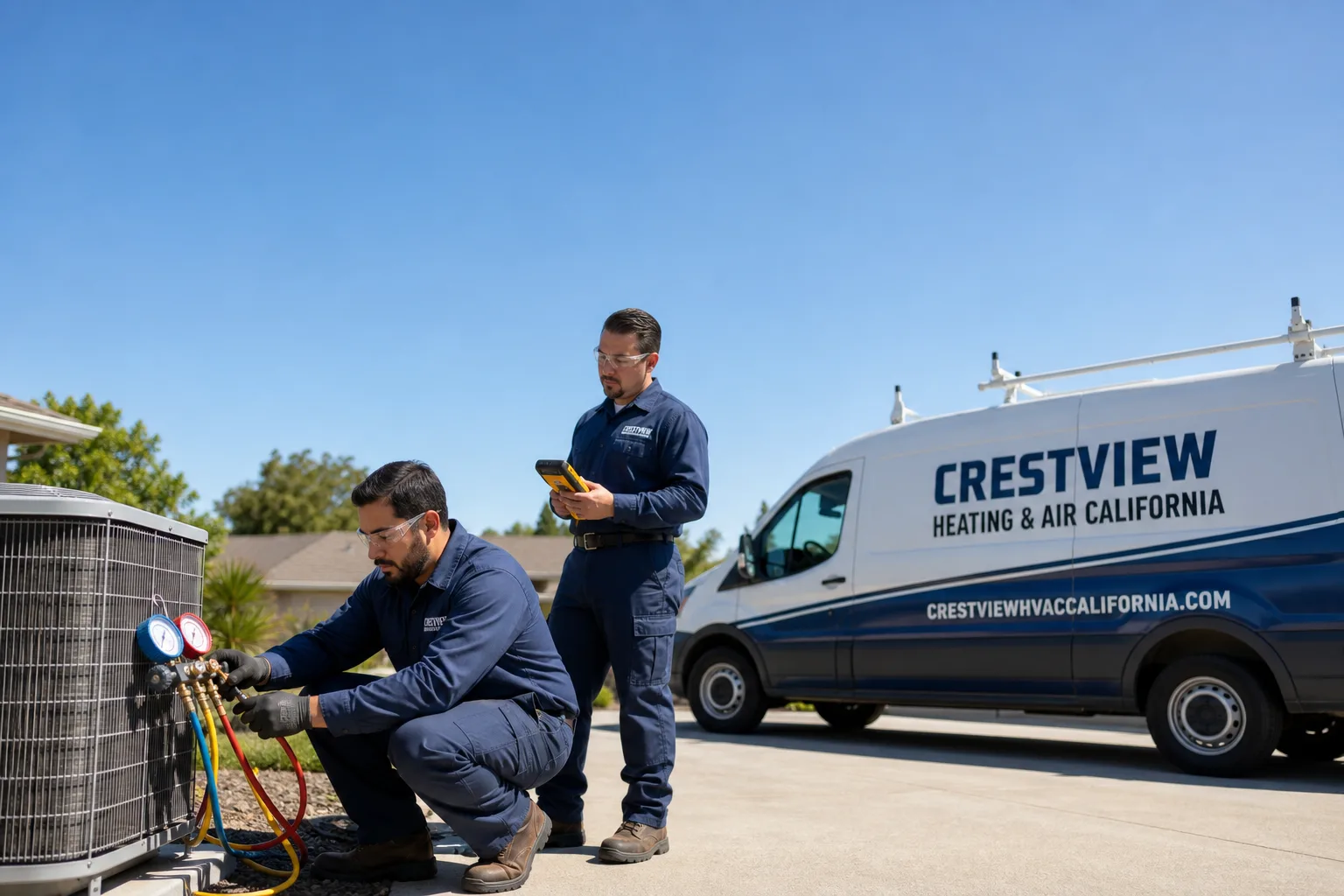
Fast, Reliable Air Quality & Ventilation Across Chinatown
Air quality and ventilation work in Chinatown runs into constraints you won’t find anywhere else in the Bay Area. The neighborhood’s post-1906 earthquake buildings share party walls, lack attics and duct chases, and sit in one of the foggiest microclimates in the continental United States. We’re Crestview Heating & Air California, and our Air Quality & Ventilation team has spent nearly two decades solving these exact problems. From SRO units above Grant Avenue restaurants to mixed-use buildings along Stockton Street, we know how to move air where conventional ductwork simply won’t fit. Call (844) 560-6978 for a free estimate — we respond to Chinatown calls with the urgency that salt-corroded vents and migrating cooking odors demand.
Why Crestview Heating & Air California Is Chinatown’s Preferred Air Quality & Ventilation Company
Our reputation in Chinatown was built job by job, not through billboard advertising. The 250+ customers who left reviews gave us a 4.8-star average, and a growing share of those reviews come from property managers in 94133 who finally found an HVAC company that understands their buildings.
Marcus Feldman, our owner, still serves as Service Manager on active jobs. That means when you call Crestview, you’re not getting a dispatcher reading from a script — you’re getting ownership-level accountability built into the schedule. We’ve walked the crawl spaces (where they exist) in Chinatown’s 3-to-6-story brick and wood-frame buildings. We know the SFDBI permit process for routing linesets through shared masonry facades. We’ve negotiated with landlords about shared exterior wall access.
Response time to Chinatown matters because ventilation failures here compound fast. A seized damper blade in a marine-fog environment doesn’t just reduce airflow — it traps grease-laden, moisture-heavy air in spaces where mold grows within days. We prioritize Chinatown calls for this reason, and we stock parts for the ductless systems that dominate this neighborhood.
Our factory training across nine major brands — including Trane, Lennox, and Rheem — means we don’t turn away jobs because “we don’t work on that.” In a neighborhood where equipment choices are dictated by building constraints, not homeowner preference, that flexibility matters.
Our Air Quality & Ventilation Services in Chinatown
Air Filtration
Chinatown’s dense commercial-residential mix creates filtration challenges suburban HVAC techs rarely encounter. Fryer exhaust from ground-floor kitchens carries grease particles that standard filters clog within weeks. We specify MERV-13 or higher filters for ductless mini-splits in these buildings, paired with activated carbon layers where odor migration is severe. A typical filtration upgrade for a Chinatown flat runs $340–$680, including filter housing modifications. We recently serviced a ground-floor bakery on Grant Avenue where decades of fryer exhaust had clogged the existing wall vent; we installed a Daikin ductless mini-split with a MERV-13 filter and a UV light to neutralize grease particles, routing the lineset through a shared masonry facade after securing permits from SFDBI.

Humidifier Install
Chinatown’s persistent damp cold — winter nights in the 50s°F with marine-layer saturation — creates a paradox: the air feels wet, but heated indoor air often drops below 30% relative humidity, irritating sinuses and cracking woodwork. Console humidifiers breed mold in these conditions. We install ductless-compatible steam humidifiers that add moisture without creating condensation on cold exterior walls. In buildings with no attic access and shallow floor-to-floor heights, we mount units on interior walls with condensate pumps to overcome the lack of gravity drains. Expect $580–$1,240 for a complete humidifier install in a typical Chinatown apartment.

Dehumidifier Install
The 94133 ZIP’s marine microclimate means baseline humidity stays elevated year-round. Add cooking moisture from dense residential occupancy, and you get wall condensation, musty odors, and accelerated mold growth. Whole-house dehumidifiers are rarely practical here — no ducts, no attic, no crawl space. We specify compact, wall-mounted dehumidifier modules that integrate with existing mini-split systems, or standalone units with continuous drain pumps for SRO configurations. A dehumidifier add-on to an existing mini-split in Chinatown typically runs $720–$1,560, depending on whether we need to run new condensate lines through masonry.

UV Air Purifier
Ultraviolet germicidal irradiation solves problems that filtration alone cannot in Chinatown’s building stock. Bacterial and fungal growth thrives in the cool, humid conditions of exterior-wall cavities where insulation is minimal. We install UV-C lamps in the air handlers of ductless mini-splits and in standalone air purifiers for units without mechanical systems. The lamps neutralize mold spores and bacteria that would otherwise circulate through party-wall gaps. UV purifier installation in Chinatown averages $440–$920 per treated zone.

ERV/HRV System
Energy Recovery Ventilators and Heat Recovery Ventilators are the most technically demanding installs we handle in Chinatown — and often the most necessary. These buildings were constructed before mechanical ventilation codes existed. Natural infiltration through deteriorated windows and wall cracks once provided enough air exchange; modern weatherization has sealed those paths while trapping pollutants inside. But standard ERV/HRV units fail here for two reasons: aluminum heat-exchange cores degrade within two years due to salt-induced pitting in the marine air, and there’s nowhere to run ducting. We specify corrosion-resistant polymer-core ERVs with dedicated wall-penetration intake/exhaust pairs, or ductless ERV units that pair room-by-room. A complete ERV installation in Chinatown runs $2,800–$5,400, with permit timelines from SFDBI adding 2–4 weeks compared to suburban jobs.

Ventilation Install
New ventilation in Chinatown means surface-mounted or wall-penetration solutions — period. We install exhaust fans with inline motors for bathrooms and kitchens, using rigid metal ducting run through exterior walls where possible, or recirculating systems with charcoal filtration where wall penetration is blocked by party-wall agreements. For commercial kitchens on the ground floor of mixed-use buildings, we engineer make-up air systems that prevent the negative pressure that pulls cooking odors upstairs into residential units. Commercial ventilation installs in Chinatown start around $1,800 and scale with hood size and make-up air requirements.

What happens when you call
- 1
A real person answersNo phone trees — you reach a local pro.
- 2
You get an upfront price rangeHonest numbers before anyone is dispatched.
- 3
A background-checked tech heads outLicensed & insured, dispatched right away.
- 4
You approve before work beginsNothing starts until you say go.
Trusted Brands We Service in Chinatown
We maintain factory-trained compatibility across Carrier, Trane, Lennox, Goodman, Rheem, York, Daikin, Bryant, and American Standard — and we stock filters, UV lamps, and core components for the brands we see most often in Chinatown’s existing installations. Daikin dominates the ductless retrofit market here for good reason: their multi-zone systems handle the heating-only bias of this climate while fitting the spatial constraints of post-earthquake construction. Goodman and Rheem components offer cost-effective reliability for landlords managing multiple SRO units. We don’t push brands that won’t perform in your specific building; we match equipment to constraints. That local parts inventory means faster turnaround when salt corrosion claims a vent hood motor or a damper seizes shut.
Common Air Quality & Ventilation Problems We See in Chinatown Homes
- Salt-laden fog destroys uncoated steel components. The marine layer that keeps Chinatown cool carries corrosive salt aerosols that attack vent hoods, damper blades, and exterior grilles. Uncoated steel hardware seizes within three to five years. We specify 316 stainless or powder-coated aluminum for any exterior-mounted ventilation component.
- Cooking odors migrate through party-wall gaps. In mixed-use buildings, the pressure differential between commercial kitchens and residential units above pulls grease-laden air through construction gaps that were never sealed. Residential ERVs designed for standard occupancy are overwhelmed. We diagnose these pathways with blower-door testing and specify targeted exhaust and make-up air solutions.
- Aluminum HRV cores fail prematurely in marine air. The damp, salt-laden environment of 94133 causes pitting corrosion in standard aluminum heat-exchange cores, destroying efficiency within two years. We specify polymer-core or coated-aluminum replacements, or shift to ERV technology with moisture-transfer membranes that tolerate the climate better.
- Wall cavities are impassable for ducting. Decades of renovations, debris accumulation, and structural modifications have filled the limited wall spaces in these post-1906 buildings. We never assume a wall can carry a duct until we’ve verified with borescope inspection. Our default assumption: surface-mounted or wall-penetration solutions only.
Pricing for Air Quality & Ventilation in Chinatown, CA
Honest numbers for a neighborhood where every job is custom:
| Service | Typical Range in Chinatown |
|---|---|
| Air filtration upgrade (MERV-13 + housing) | $340–$680 |
| Humidifier install (ductless-compatible) | $580–$1,240 |
| Dehumidifier add-on to mini-split | $720–$1,560 |
| UV air purifier installation | $440–$920 |
| Ventilation install (residential exhaust) | $1,800–$3,600 |
| ERV/HRV system (complete, permitted) | $2,800–$5,400 |
What moves the needle on cost: SFDBI permit requirements for any exterior wall penetration; shared-facade negotiations with neighboring property owners; masonry drilling versus wood-frame routing; and whether we can access electrical panels without conduit runs through finished spaces. We provide itemized, upfront pricing before work begins — no open-ended hourly billing. Call (844) 560-6978 for a free estimate. We’ll walk your building, identify the constraints, and give you real numbers.
We Also Serve Cities Near Chinatown
Our service radius extends throughout San Francisco and into neighboring communities. We regularly handle Air Quality & Ventilation calls in the Mission District, Noe Valley, and Visitacion Valley — each with their own building-stock quirks and microclimate considerations. Whether you’re managing a mixed-use property in Chinatown or need ventilation service at a residence across the city, the same owner-managed team responds.
Serving Chinatown, CA — Our Local Coverage Area
We’re based in the Chinatown area and know this community well. Use the map below to see our service coverage — if you’re nearby, we can almost certainly help.
FAQs — Air Quality & Ventilation in Chinatown
Yes — we specify wall-penetration or ductless ERV units designed for buildings exactly like yours. In Chinatown’s post-1906 construction, duct chases virtually never exist, so we engineer room-by-room solutions with dedicated intake and exhaust ports through exterior walls. The SFDBI permit process adds 2–4 weeks, but the installation itself is straightforward once approved. Call (844) 560-6978 to schedule a site assessment — estimates are free.
Negative pressure from commercial kitchen exhaust downstairs is pulling air through gaps in your party wall or shared ductwork. This is extremely common in Chinatown’s mixed-use buildings. We diagnose the pressure pathways with specialized testing, then install backdraft dampers, seal construction gaps, or add dedicated make-up air to the commercial space to eliminate the suction. The fix typically runs $680–$1,400 depending on access and extent.
Yes — San Francisco’s Department of Building Inspection requires permits for any range hood replacement that alters exhaust capacity or routing, which includes virtually every SRO installation. In Chinatown’s historic mixed-use buildings, the permit review also checks compliance with shared-facade agreements and fire separation requirements. We handle permit submission as part of our installation service. Expect 2–3 weeks for approval before work can begin.
MERV-13 pleated filters with activated carbon layering, changed every 6–8 weeks in commercial-adjacent units. The high humidity in 94133 causes standard filters to load with moisture and mold; the carbon layer captures grease and odor particles that are ubiquitous near Chinatown’s ground-floor kitchens. We stock these filters and can set up subscription delivery. A year’s supply runs $180–$280.
In most cases, yes — either through a dedicated dehumidifier module that integrates with your Daikin, Lennox, or Rheem mini-split, or as a standalone wall-mounted unit with condensate pump. The humid marine climate of Chinatown makes dehumidification a higher priority here than in almost any other Bay Area neighborhood. Integration costs $720–$1,560; call (844) 560-6978 for exact pricing on your system.
Ready to solve the air quality problems that come with Chinatown’s unique building stock and coastal climate? Call Crestview Heating & Air California at (844) 560-6978. Marcus Feldman or a member of our owner-managed team will visit your property, assess the constraints, and provide a free, itemized estimate with no pressure to commit. We’ve spent 19 years earning the trust of Bay Area property owners — let us show you what that experience means in practice.
Written by Marcus Feldman, Owner and Service Manager at Crestview Heating & Air California, serving Chinatown and the greater San Jose area since 2006.