
Heating & Furnace: Repair or Replace? How San Jose Homeowners Decide
Most San Jose furnaces should be repaired if they’re under 12 years old and the fix costs less than $3,500, but replaced if the heat exchanger is cracked, repair frequency exceeds once per season, or efficiency gains would pay back within 5-7 years at current PG&E rates. The mild South Bay climate masks problems that become dangerous or expensive fast. If you’d rather not sort this out alone, call us at (844) 560-6978 for a free, no-pressure estimate.
San Jose homeowners replace their furnaces an average of three years later than homeowners in colder climates — not because the equipment lasts longer, but because mild winters hide how badly a system is underperforming. A furnace cycling on and off at 3 a.m. in January doesn’t feel like an emergency when it’s 45°F outside. But that same unit is wasting gas, stressing components, and in some cases venting carbon monoxide. We’ve spent nearly two decades in San Jose homes from Willow Glen to Almaden Valley, and we’ve learned that the repair-or-replace decision here follows different rules than the national advice you’ll find online.
Why San Jose’s Short Heating Season Changes the Math
Conventional wisdom says replace a furnace when repair costs approach 50% of replacement cost. That rule comes from Minnesota. In San Jose, where a furnace might run 800-1,200 hours per year versus 2,500+ in cold climates, the calculation shifts.
Here’s what most competitors miss: shorter run hours can actually justify earlier replacement when gas prices spike. A 15-year-old 80% AFUE furnace burning 40% more gas per therm than a new 96% condensing unit doesn’t need 2,000 hours to waste serious money. At current PG&E baseline rates, that efficiency gap costs San Jose homeowners $180-$340 per heating season even with our mild winters. Over 8-10 years, that’s real money — and that’s before factoring in repair bills on aging components.
We replaced a Bryant system last month in a Naglee Park home where the owner had nursed a failing furnace through three winters. The repair bills totaled $4,200. A new American Standard unit would have cost $5,800 installed. He paid 72% of replacement cost for temporary fixes, then paid full replacement cost anyway. In our experience, San Jose homeowners who hit $2,500 in cumulative repairs on a unit over 10 years old are usually throwing money away.
The flip side: if your furnace is 8 years old, running fine, and needs a $400 ignitor replacement, repair is almost always the right call. The equipment has plenty of life, and the payback period on a new unit won’t justify the capital outlay.
The Heat Exchanger Crack: When Replacement Is Non-Negotiable
A cracked heat exchanger is the one diagnosis where we never recommend repair. Never. This is the component that separates combustion gases from your breathable air. A crack means carbon monoxide can enter the supply plenum. In San Jose, where many homes built in the 1960s-1980s have furnaces in garages or closet spaces with limited ventilation, the risk profile is worse than national averages suggest.
We’ve seen competitors quote $1,800-$2,400 to “patch” or replace just the heat exchanger. Here’s why that’s problematic:
- Most manufacturers void the remaining warranty when a heat exchanger fails, because it’s typically a symptom of larger system stress
- The labor to remove and replace a heat exchanger often approaches 60-70% of full replacement labor
- By the time a heat exchanger cracks, other components (blower motor, gas valve, control board) are usually near end of life
- No reputable technician can guarantee a patch won’t leak; CO is odorless and cumulative
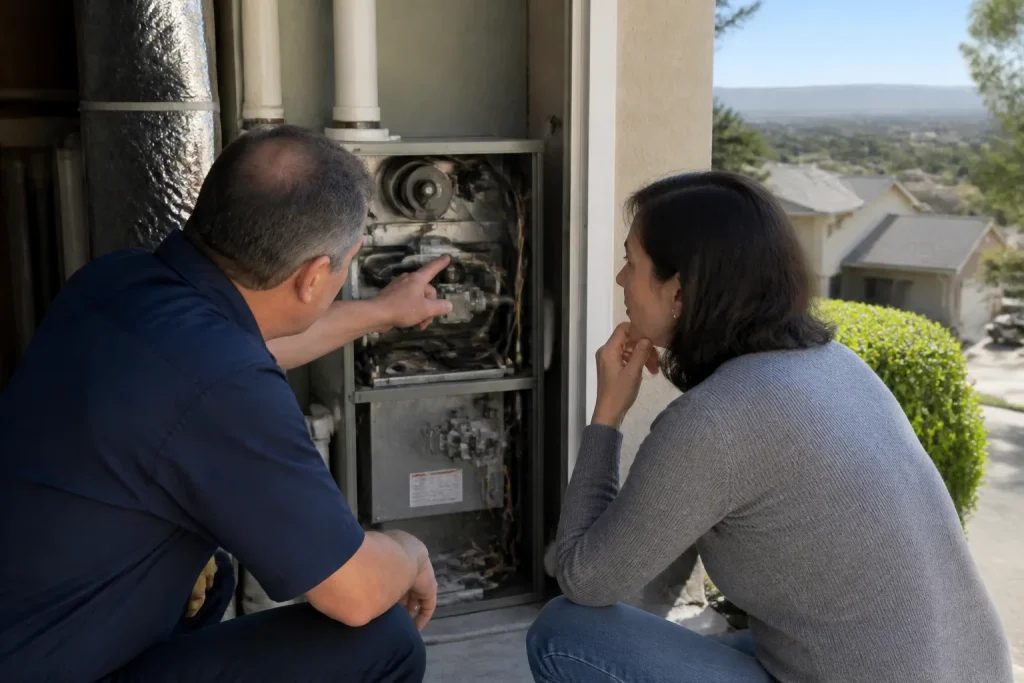
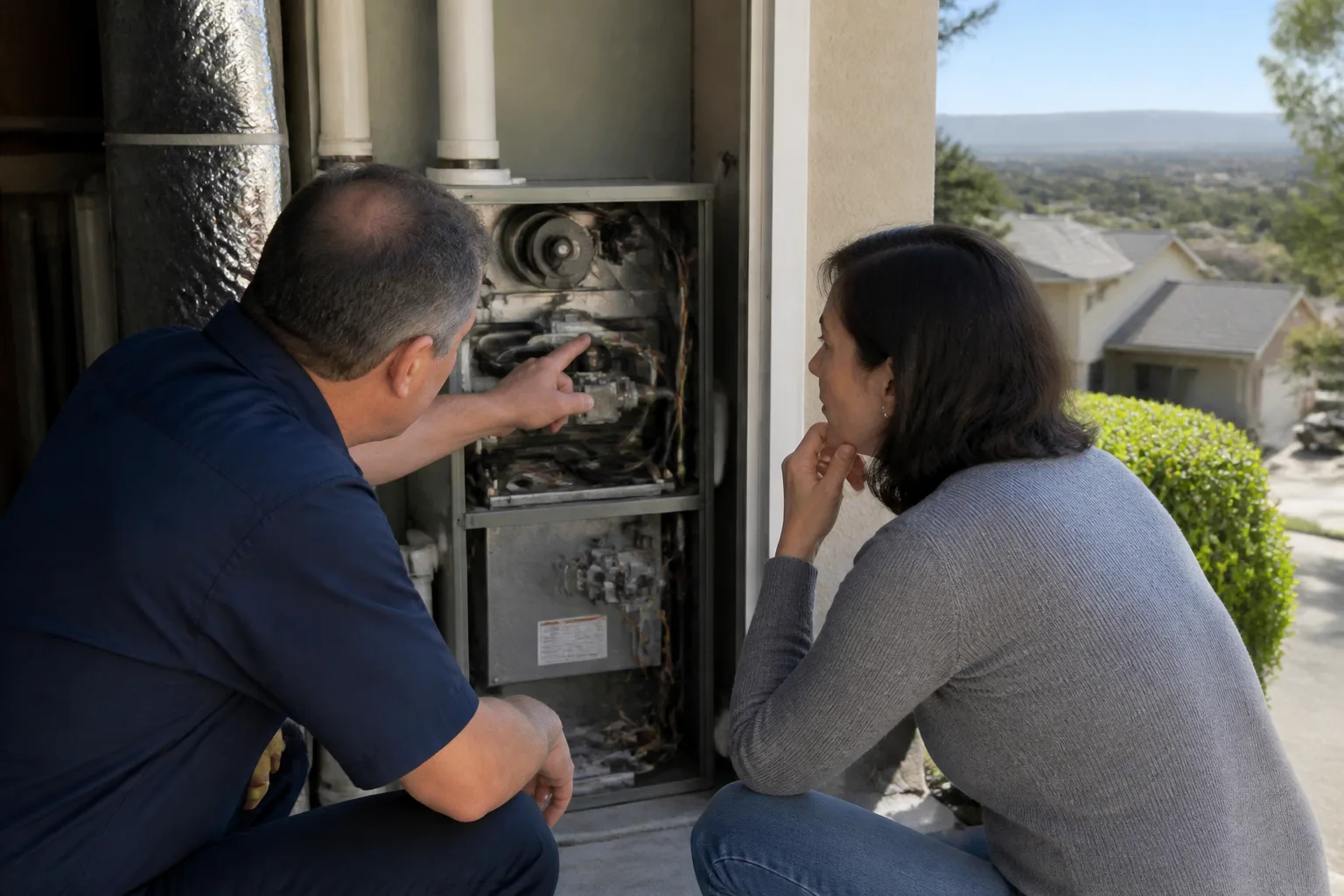
Getting a second opinion: If a technician flags a cracked heat exchanger, ask to see the crack with a borescope camera. A legitimate crack is visible. If they refuse visual verification, call another company. At Crestview, we show homeowners what we see. We’ve had customers in Evergreen and Cambrian Park get quoted heat exchanger replacements that turned out to be simple limit switch failures — a $200 repair, not a $6,000 replacement.
If the crack is real, we recommend full replacement. Period. Your family’s safety isn’t a negotiable line item.
California Title 24: What You Can Actually Install
California’s Title 24 energy standards constrain what replacement equipment qualifies for installation, and this catches San Jose homeowners off guard. You can’t simply swap like-for-like in many cases.
Current standards require:
- Minimum 81% AFUE for furnace-only replacements in most climate zones (San Jose is Climate Zone 12)
- Integrated furnace-air handler combinations must meet stricter blower efficiency requirements
- Duct sealing verification if you’re replacing a system over 15 years old
What this means practically: that cheap 80% AFUE furnace your uncle installed in Ohio won’t pass inspection here. Most San Jose replacements now involve 92-96% AFUE condensing furnaces or heat pump conversions. The upside? Pacific Gas & Electric offers rebates through their Energy Upgrade California program, and federal tax credits under the Inflation Reduction Act can offset $600-$2,000 of qualified installation costs depending on equipment efficiency.
We’ve guided dozens of San Jose homeowners through the rebate paperwork. It’s not complicated, but the equipment must be pre-qualified and installed by a contractor who documents properly. We handle this as standard practice — not an upsell.
Related services in San Jose: If you’re considering whether a heat pump might replace both your furnace and aging AC, see our Heat Pump & Mini Split in San Marcos page for how these systems perform in our climate.
The Age-Plus-Repair-Frequency Matrix for San Jose
National HVAC advice says replace at 15-20 years. For San Jose, we’ve developed a more useful framework based on actual local usage patterns and PG&E rate structures:
| Age + Condition | Recommended Action | Typical Cost Range |
|---|---|---|
| Under 10 years, first major repair | Repair | $250-$800 |
| 10-14 years, first repair in 3+ years | Repair if under $1,500 | $400-$1,500 |
| 10-14 years, second repair in 2 years | Evaluate replacement | Compare repair vs. $5,500-$8,500 |
| 15+ years, any repair over $1,000 | Strongly consider replacement | $5,500-$9,500 |
| Any age, cracked heat exchanger | Replace | $5,500-$9,500 |
| Any age, failed main control board + other issues | Usually replace | Compare cumulative costs |
These thresholds sit lower than national averages because San Jose’s high utility rates accelerate the payback on efficient equipment, and because our mild climate means furnaces often get neglected until catastrophic failure. A system that runs 900 hours a year but hasn’t been serviced since 2019 is often in worse shape than a Minnesota furnace with annual maintenance.
We serviced a Carrier unit in Rose Garden last winter — 16 years old, never maintained, with a failed inducer motor and degraded ignitor. The repair quote was $1,840. The owner initially balked at replacement. Then we showed him his gas usage versus a same-size home with a 96% AFUE unit: he was paying $340 more per year for heat. At 8 years of remaining life, the new furnace pays for its incremental cost in utility savings alone. He replaced it.
What a Tune-Up Can and Cannot Fix
Annual furnace maintenance is worth it. But honest technicians should tell you what it actually accomplishes versus what gets temporarily masked.
A proper tune-up addresses:
- Dirty burners causing incomplete combustion and soot buildup
- Loose electrical connections creating intermittent failures
- Clogged condensate drains (critical for high-efficiency condensing furnaces)
- Improper gas pressure or airflow causing short-cycling
- Worn blower belts and dirty coils reducing efficiency
A tune-up cannot fix:
- Heat exchanger cracks or metal fatigue
- Control board failures from age and thermal cycling
- Inducer motor bearing wear (temporary lubrication helps, but replacement is coming)
- Gas valve degradation causing erratic flame patterns
- Heat exchanger rust from condensate drainage failures
The dangerous middle ground: a technician “tunes up” a system with a failing heat exchanger or cracked collector box, charges $189, and sends the homeowner away thinking the problem is solved. We’ve been called to homes in West San Jose where exactly this happened — the tune-up masked symptoms for six weeks, then the system failed completely on a cold night. If your technician can’t explain why the failure occurred and what prevents recurrence, get another opinion.
When to call a pro: If your furnace is making new noises, cycling irregularly, or your CO detector has chirped even once, stop using it and call for inspection. We answer emergency calls for exactly these situations — not dramatic, but genuinely unsafe.
The Bottom Line
San Jose’s mild winters create a dangerous illusion of time. The repair-or-replace decision should weigh: cumulative repair costs against replacement, current PG&E rates against efficiency gains, equipment age against realistic remaining life, and safety factors like heat exchanger integrity that override pure economics.
Key takeaways for San Jose homeowners:
- Repair single incidents on furnaces under 12 years old if costs stay under $1,500
- Replace any furnace with a confirmed heat exchanger crack, regardless of age
- Factor California Title 24 requirements and available rebates into replacement quotes
- Consider replacement when cumulative repairs exceed $2,500 on units over 10 years old
- Don’t let mild weather delay decisions — inefficient heating wastes money even in 45°F nights
If you’re weighing repair versus replacement on your San Jose furnace, Crestview Heating & Air California offers free, no-obligation estimates. We’ll show you what we find, explain your options without pressure, and help you make the decision that fits your budget and your home. Call (844) 560-6978 or reach out through our site to schedule.
Frequently Asked Questions
Most furnace repairs in San Jose range from $250 for simple fixes like ignitor or flame sensor replacement to $1,800 for complex issues like inducer motor or control board failure. Heat exchanger replacement, when attempted, typically runs $1,800-$2,800 but we generally don’t recommend it. Call (844) 560-6978 for an exact quote on your specific system — estimates are free.
Repair is cheaper in the short term for single failures on younger systems. Replacement becomes cheaper over 5-10 years when cumulative repairs exceed $2,500, efficiency gains save $180-$340 annually on PG&E bills, or the system is over 15 years old. We calculate true lifecycle costs for San Jose homeowners, not just sticker price. Call us for a free comparison.
We offer same-day service for most furnace repairs in San Jose when you call by early afternoon, and emergency HVAC service for no-heat situations outside normal hours. We stock common parts for Carrier, Trane, Bryant, American Standard, and other major brands. For emergency service, call (844) 560-6978.
With proper maintenance, 15-20 years is realistic in San Jose’s mild climate, but lifespan doesn’t equal economic life. Many furnaces become inefficient money pits after 12-14 years due to component degradation and outdated technology. We’ve replaced 22-year-old units still running and 10-year-old units that weren’t worth fixing — it depends on maintenance history, usage patterns, and repair record.
Written by Marcus Feldman, Owner & Service Manager at Crestview Heating & Air California, serving San Jose since 2007.
Need HVAC Help?
Call Crestview Heating & Air California — licensed & insured, here with fast after-hours help in California.
(844) 560-6978