
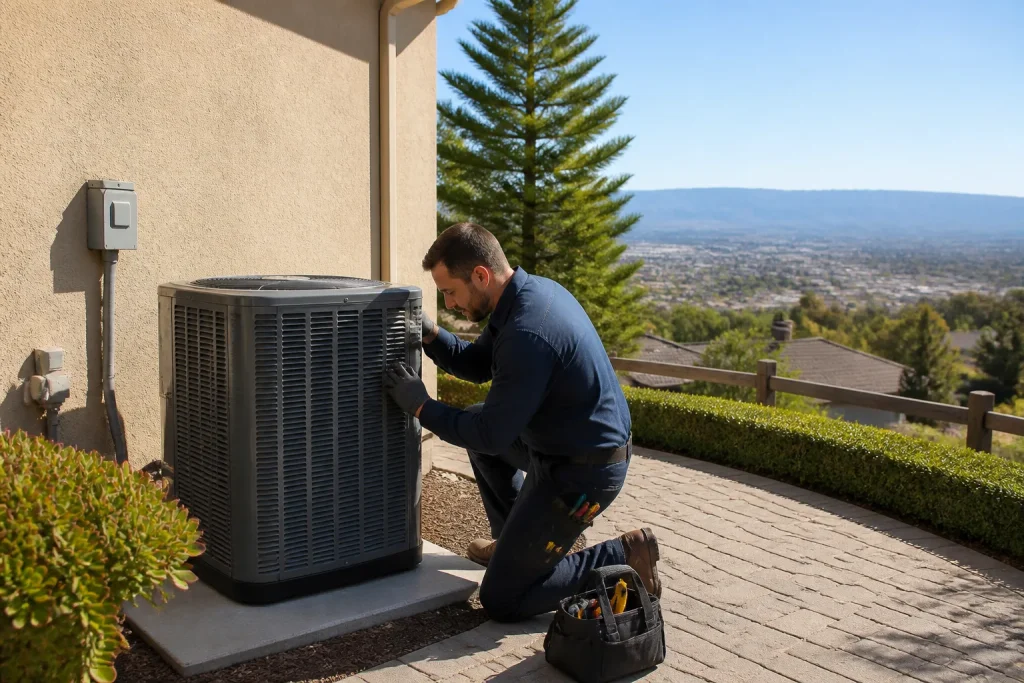
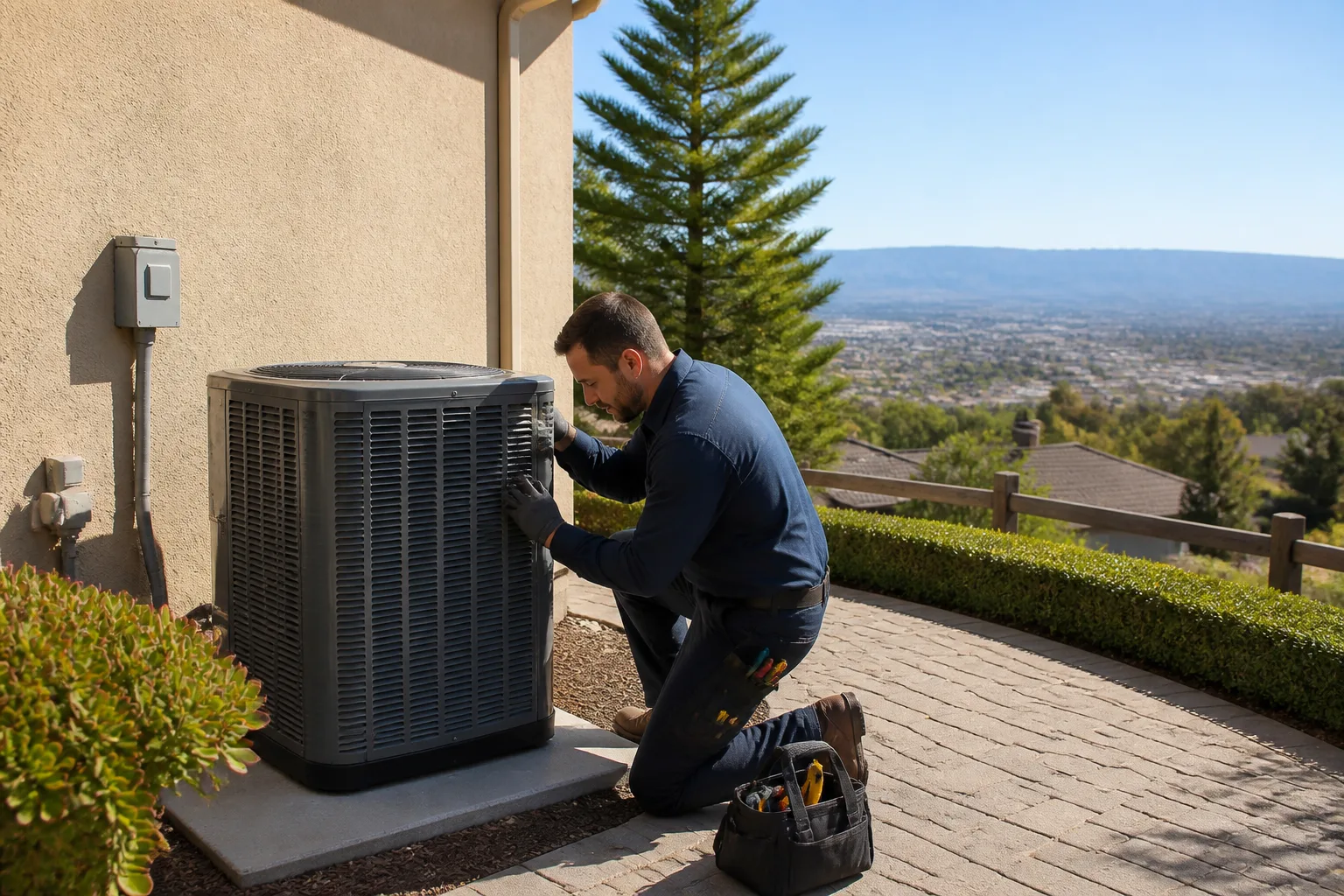
American Standard AC Repair & Installation in San Jose: A Homeowner’s Guide
American Standard AC repair and installation in San Jose typically costs between $180 for minor repairs and $6,500–$9,500 for a full variable-speed system replacement, with most service calls completed same-day. The brand shares its core components with Trane but has a smaller dealer network in the South Bay, which affects parts availability and warranty support. If you’d rather not sort through dealer certifications and compatibility charts yourself, call us at (844) 560-6978 for a free estimate.
Here’s what most homeowners miss: American Standard has one of the lowest compressor failure rates in the industry — Trane’s own engineering data backs this up — yet it consistently underperforms Trane in owner satisfaction surveys. The gap isn’t product quality. It’s service access. In markets like San Jose, where the certified dealer footprint is thinner, homeowners wait longer for parts and struggle to find technicians who understand the brand’s communicating systems. That frustration shows up in reviews that blame the equipment when the real problem is who installed or serviced it.
What’s Actually Inside an American Standard AC?
American Standard and Trane are built on the same assembly lines by Ingersoll Rand. The Spine Fin aluminum coil, the Climatuff scroll compressor, the heavy-gauge galvanized steel cabinet — identical. In our 19 years servicing San Jose, we’ve opened units from both brands that came off the same Texas production line in the same week with different nameplates.
But “same” has limits. Three areas catch homeowners and even some contractors off guard:
- Control boards: American Standard uses a proprietary communicating protocol for its AccuComfort variable-speed systems. The board part numbers differ from Trane equivalents, and cross-wiring them voids the warranty.
- Thermostats: The American Standard Gold 824 and Platinum 1050 thermostats look like Trane’s Nexia line but run different firmware. Pairing the wrong stat to the wrong board creates “ghost” error codes that send technicians down rabbit holes.
- Condenser fan motors: American Standard’s 4-wire variable-speed fan motors have a different resistance profile than Trane’s 3-wire equivalents. Swapping them burns out the board in about six weeks, usually in August when every San Jose HVAC company is booked solid.
We learned that last one the hard way on a job in Willow Glen about eight years ago. Customer had a “friend who knew AC” replace the motor. We got the call when the second board failed. Now we always verify part numbers against the American Standard service bulletin, not just the Trane cross-reference.
How AccuComfort Performs in San Jose’s Climate
American Standard’s AccuComfort variable-speed technology adjusts compressor output in 1/10th of one percent increments, running longer cycles at lower capacity instead of blasting full-on then shutting off. The SEER2 ratings look impressive — up to 24.5 on the Platinum 20 — but here’s what the brochure won’t tell you about San Jose specifically.
Our cooling load is mild compared to Phoenix or Sacramento. We see maybe 15–20 days above 90°F in a typical Almaden Valley summer. That means a variable-speed system spends most of its life in the 30–60% capacity range, where the efficiency gains are real but smaller than the peak SEER2 number implies. You’re not wrong to buy one. Just don’t expect your electric bill to drop 40% if you’re coming from a 14 SEER single-stage unit. In our experience across San Jose, 20–25% savings is more realistic for most homes, with the bigger payoff being humidity control and temperature consistency.
The coastal influence matters too. In neighborhoods near the bay like West San Jose or North San Jose, morning fog keeps dew points higher. A single-stage system that short-cycles never pulls enough moisture out. AccuComfort’s long, low runs solve that. We’ve had customers in Santa Teresa drop from 58% indoor humidity to 48% without changing anything else.
The Repairs We See Most on American Standard Units in Northern California
After nearly two decades working on these systems from Morgan Hill to Menlo Park, three failure patterns stand out. They’re all preventable with proper installation and maintenance, but they’re also the ones that stump technicians who don’t know the brand.
TXV screen restrictions. American Standard’s thermal expansion valves have a fine-mesh inlet screen that catches debris from brazing flux and installation particulate. In hard water areas like parts of East San Jose, mineral scale adds to the clog. The symptom is high subcooling, low suction pressure, and a compressor that runs hot. Cleaning the screen takes 20 minutes if you know it’s there. We’ve seen units misdiagnosed as “low refrigerant” three times in one season, with refrigerant added that just made the problem worse.
Capacitor failures on 4-wire fan motors. The variable-speed motors draw startup current differently than traditional PSC motors. The run capacitor sees more thermal cycles, and in San Jose’s inland valleys where afternoon temperatures spike — think Evergreen or Berryessa — capacitor life drops from a typical 10–12 years to 6–8. We now recommend capacitor testing at every maintenance visit for AccuComfort systems over five years old.
Climatuff compressor contactor wear. The contactor points pit faster on variable-speed systems because they cycle more frequently. Not the compressor itself — the contactor. A $45 part that, when it fails, takes out the compressor if it chatters long enough. We caught one in Cambrian Park last spring that was arcing so badly it had welded half-shut. Another week and the homeowner would have been looking at a $3,200 compressor replacement instead of a contactor swap.
How to Verify a Contractor Actually Knows American Standard
Any technician can say “we work on all brands.” That doesn’t mean they have current access to American Standard’s technical documentation, warranty registration portal, or dealer pricing on proprietary parts.
Here’s what to check:
- Ask for their dealer number. American Standard certifies dealers through a program called Customer Care. A legitimate dealer has a number you can verify through American Standard’s website or by calling their dealer support line.
- Check for factory training credentials. Look for NATE certification with American Standard-specific modules, or recent attendance at Ingersoll Rand factory training. Ask when they last attended. “A few years ago” means their knowledge is stale — the AccuComfort platform changed significantly in 2020.
- Request a parts availability timeline. If they say “two weeks for a board,” they don’t stock American Standard inventory and probably aren’t ordering through the dealer channel. We keep Spine Fin coils, control boards, and the full capacitor range on our San Jose trucks because we’ve learned what fails.
- Review their warranty registration process. American Standard requires online registration within 60 days of installation for full 10-year parts coverage. A contractor who says “you’ll get a card in the mail” or who handles registration casually is either uninformed or cutting corners.
At Crestview Heating & Air California, we maintain active dealer status and factory training across all nine major brands we service, including American Standard. Owner-managed, not outsourced, means Marcus Feldman personally verifies every warranty registration before the job closes.
What the 10-Year Warranty Actually Covers (and Doesn’t)
The standard American Standard warranty is 10 years on parts, 10 years on the compressor, and 20 years or lifetime on certain heat exchangers, depending on the model. But “parts” has boundaries most homeowners don’t discover until something fails in year seven.
Covered: Compressor, condenser coil, evaporator coil, control board, reversing valve, TXV, fan motor, contactor, capacitors, and the outdoor sensor package.
Not covered: Refrigerant (ever), electrical fuses, drain line stoppages, filters, thermostat batteries, and any damage from improper installation, lack of maintenance, or power surges. That last one matters in San Jose, where PG&E’s grid stability in older neighborhoods like Japantown or the Alameda can be spotty during heat waves.
The warranty also requires proof of annual maintenance by a qualified technician starting in year two. Skip a year, and American Standard can deny a claim. We’ve seen it happen. Keep your invoices.
One more San Jose-specific note: if you’re in a high-wind exposure zone near the foothills — Alum Rock, Evergreen, parts of Silver Creek — the warranty excludes damage from foreign objects or debris impact. That means a branch through the coil after a Santa Ana wind event is an insurance claim, not a warranty claim. Know your coverage before you need it.
When to Repair vs. Replace Your American Standard AC
This is the call we help San Jose homeowners make every week. Our rule of thumb, refined over 250+ reviews and nearly two decades in the field:
- Under 8 years and the repair is under $800: fix it, especially if it’s a capacitor, contactor, or minor refrigerant issue.
- 8–12 years with a major failure (compressor, coil, board): get a replacement quote alongside the repair estimate. At this age, efficiency gains from a new AccuComfort system often justify the investment, particularly with utility rebates.
- Over 12 years: replace unless the repair is trivial. R-22 phaseout means refrigerant costs alone can turn a $400 repair into $1,200. Even R-410A systems this old are approaching end-of-life for compressor technology.
We’re not in the business of selling equipment people don’t need. We’ve talked homeowners out of replacement when a $200 TXV cleaning bought them three more seasons. But we’ve also seen people throw $1,800 at a 14-year-old system that failed again six months later. The honest assessment is what 250+ customers who left reviews agree sets us apart.
Related Services in San Jose
American Standard systems often pair with heat pumps or mini-split configurations for zoned cooling in larger San Jose homes. If you’re considering a whole-home upgrade, explore our Heat Pump & Mini Split in San Marcos options, or for winter readiness, our Heating & Furnace in San Marcos service page. We also handle AC Repair & Installation in San Marcos for properties outside our immediate San Jose zone.
What happens when you call
- 1
A real person answersNo phone trees — you reach a local pro.
- 2
You get an upfront price rangeHonest numbers before anyone is dispatched.
- 3
A background-checked tech heads outLicensed & insured, dispatched right away.
- 4
You approve before work beginsNothing starts until you say go.
The Bottom Line
American Standard builds excellent equipment — same guts as Trane, same reliability record, often better pricing. But the brand’s value in San Jose depends entirely on who installs and services it. The thinner dealer network means more homeowners end up with technicians who treat it like generic equipment, miss the proprietary details, and blame the manufacturer when things go wrong.
Key takeaways:
- American Standard and Trane share most components, but control boards, thermostats, and fan motors are not interchangeable.
- AccuComfort variable-speed systems deliver real comfort benefits in San Jose’s mild, occasionally humid climate, but expect 20–25% energy savings, not miracle bills.
- TXV screens, capacitors, and contactors are the three failure points we see most — all preventable with knowledgeable maintenance.
- Verify dealer certification before you hire; ask for specific training credentials and parts availability.
- Register your warranty within 60 days and keep annual maintenance records or risk coverage denial.
If you’re in San Jose and need help with an American Standard system — whether it’s a repair quote, a replacement comparison, or just a second opinion on another contractor’s diagnosis — Crestview Heating & Air California offers free estimates. Call (844) 560-6978 and ask for Marcus. From emergency calls to commercial buildouts, your system is our specialty.
Frequently Asked Questions
Minor repairs like capacitor or contactor replacement typically run $180–$450. Major repairs — compressor replacement, coil replacement, or control board failure — range from $1,200–$2,800 depending on the model and refrigerant type. Diagnostic fees in the South Bay average $89–$129, though we waive ours with repair authorization. Call (844) 560-6978 for an exact quote — estimates are free.
Generally yes, by 5–10% at equivalent efficiency tiers, because American Standard’s marketing spend is lower and the dealer network pricing structure differs. The equipment itself is built on the same lines with the same core components. Where you may pay more is in service access if your local dealer options are limited, which is why we emphasize choosing a contractor with active certification and stocked parts.
Any licensed technician can legally service the equipment, but American Standard’s communicating systems — AccuComfort variable-speed units — require specific training to diagnose properly. Generic technicians often misread error codes, install incompatible parts, or fail to register warranties correctly. We recommend asking for factory training credentials and a current dealer number before hiring.
Call American Standard’s warranty line with your serial number, or check your original installation paperwork for the registration confirmation. Valid warranties require online registration within 60 days of installation and proof of annual maintenance from year two onward. If you bought the home from a previous owner, the warranty may not transfer unless registration was updated — another detail we verify during every service call in San Jose.
Written by Marcus Feldman, Owner & Service Manager at Crestview Heating & Air California, serving San Jose since 2007.
Need HVAC Help?
Call Crestview Heating & Air California — licensed & insured, here with fast after-hours help in California.
(844) 560-6978