
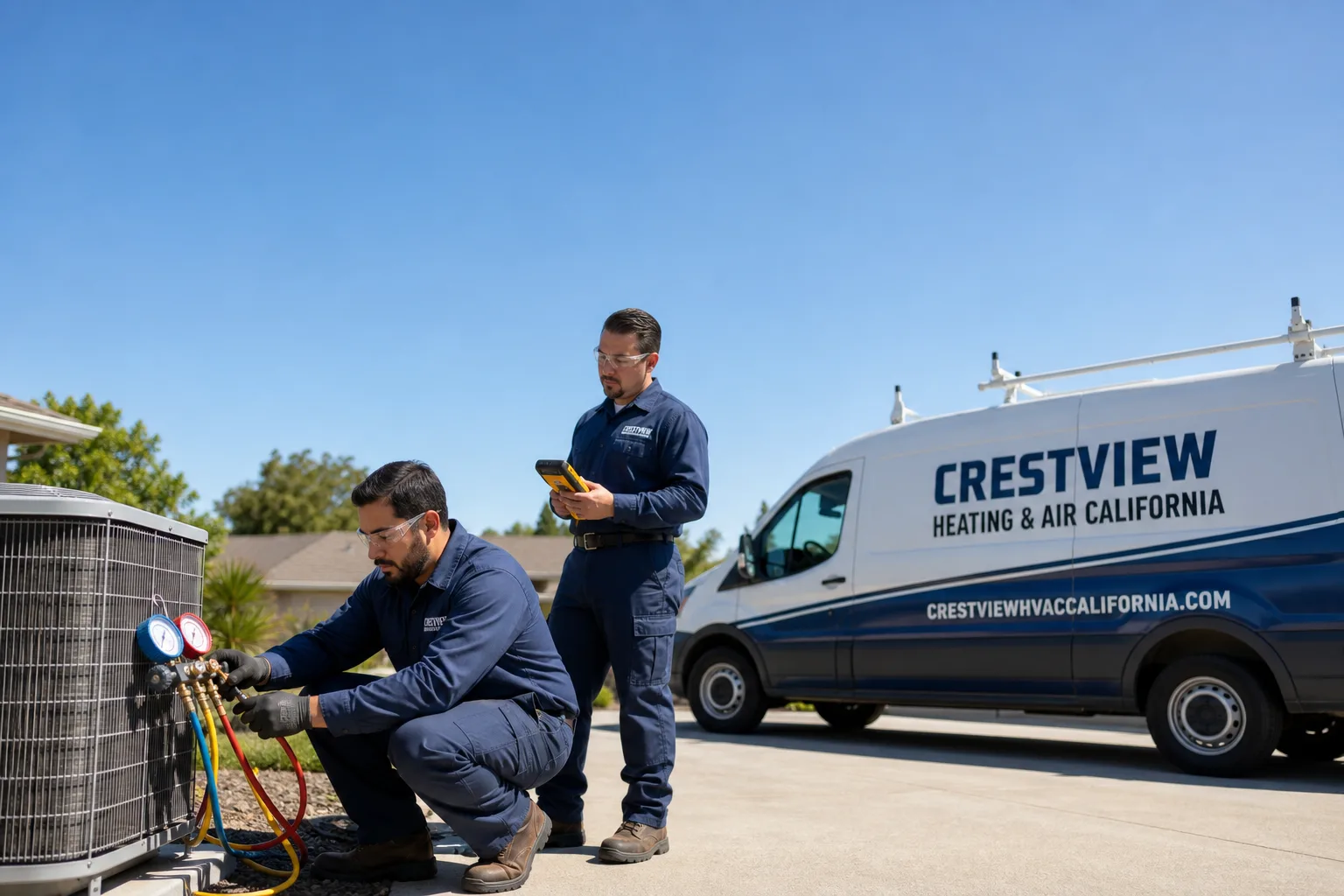
Fast, Reliable Emergency & Commercial HVAC Across Scotts Valley
Emergency and commercial HVAC repair in Scotts Valley typically runs $150–$700 for same-day fixes, with full system installations ranging $3,500–$7,500. We’re Crestview Heating & Air California, and our Emergency & Commercial HVAC team reaches Scotts Valley from our San Jose base with the parts and factory training to handle whatever system you have. Call (844) 560-6978 for a free estimate.
Scotts Valley sits in that sheltered mountain valley where winter frost forms on the floor while Santa Cruz stays mild, and summer afternoons push into the upper 80s and 90s while the coast barely breaks 70. That dual-season reality means your HVAC system works hard year-round, whether it’s a 1980s gas furnace in a Granite Creek tract home or a rooftop unit serving a commercial strip off Scotts Valley Drive. We’ve spent nearly two decades servicing this exact geography, and we know which failures show up first when the temperature drops or spikes.
Why Crestview Heating & Air California Is Scotts Valley’s Preferred Emergency & Commercial HVAC Company
Our 4.8-star average across 250+ reviews comes from showing up with the right parts and the owner still managing jobs in the field. Marcus Feldman doesn’t delegate from an office — he serves as Service Manager, which means ownership-level accountability is built into how we dispatch, diagnose, and follow up on every Scotts Valley call. When you reach us at (844) 560-6978, you’re talking to a team where the person answering understands the job, not a call center reading a script.
That matters in Scotts Valley because the housing stock here creates problems that coastal techs rarely see. The valley floor at 500–900 feet elevation traps cold air on still nights, producing thermal inversions that stress heat pumps differently than anywhere in Santa Cruz County. We’ve replaced cracked heat exchangers in original 1980s Carrier furnaces on Whispering Pines Drive, redesigned ductwork for AC retrofits in 1970s ranch homes near Vine Hill, and troubleshot defrost failures on commercial heat pumps at lower elevations that techs from the coast misdiagnosed. That local pattern recognition saves you time and money.
We carry factory-authorized parts for Trane, Lennox, Goodman, and Rheem — the brands we see most often in Scotts Valley’s older housing stock — so we’re not ordering overnight and making you wait. Our emergency line stays open when systems fail outside normal hours because we know a dead furnace in January or a failed AC in August isn’t a tomorrow problem in this valley.
Our Emergency & Commercial HVAC Services in Scotts Valley
24/7 Emergency HVAC
HVAC failures in Scotts Valley don’t follow business hours. A cracked heat exchanger in a commercial building on Scotts Valley Drive at 10 PM, a dead blower motor during a January freeze, a refrigerant leak when the valley hits 92 in July — we answer the phone and dispatch with parts for the nine major brands we service. Our emergency response covers both ZIP codes 95066 and 95067, from the valley floor up to the ridgeline neighborhoods. We don’t charge premium rates just for the “emergency” label, and we’ll tell you honestly if a same-night repair is safe or if temporary heat/cooling makes more sense until morning.

Commercial HVAC
Scotts Valley’s commercial base runs from small retail on Mount Hermon Road to office parks and light industrial near Granite Creek. These systems face the same valley-floor thermal inversions as residences, but with higher stakes — tenant complaints, code compliance, and equipment running longer hours. We service packaged rooftop units, split systems, and heat pumps for commercial clients, with Marcus Feldman personally reviewing load calculations for any replacement. Commercial installations here often need defrost logic configured specifically for the elevation and exposure, not a factory default meant for coastal climates.

Rooftop Unit Service
Scotts Valley’s commercial rooftops collect debris from the surrounding oak and redwood canopy, and the temperature swings between frosty winter mornings and hot afternoons stress seals, belts, and refrigerant lines. We inspect, repair, and replace RTUs with factory-trained procedures for Carrier, Trane, Lennox, and the other major brands. A common issue we find: RTUs installed with standard defrost settings that don’t account for the valley’s cold-air pooling, leading to unnecessary energy use and shortened compressor life. We reconfigure these for local conditions.

Chiller Service
For larger commercial facilities in Scotts Valley with process cooling or high-capacity comfort systems, chiller failures can halt operations entirely. We diagnose refrigerant circuits, compressor issues, and control failures, with the technical depth that comes from 19 years across every system type. Chillers in this climate face particular stress from the wide delta between winter lows and summer highs — expansion and contraction fatigues fittings and gaskets over seasons. We catch that wear before it becomes a shutdown.

HVAC Inspection
Before you buy a commercial property in Scotts Valley or renew a lease with HVAC responsibility, an inspection by someone who knows this valley’s conditions pays for itself. We document equipment age, remaining service life, and the specific risks posed by thermal inversions and electrical panel capacity. Many 1970s–1990s buildings here have furnace-only systems with panels that can’t support added AC without upgrade — a $2,000–$4,000 surprise if you don’t catch it in diligence.

What happens when you call
- 1
A real person answersNo phone trees — you reach a local pro.
- 2
You get an upfront price rangeHonest numbers before anyone is dispatched.
- 3
A background-checked tech heads outLicensed & insured, dispatched right away.
- 4
You approve before work beginsNothing starts until you say go.
Trusted Brands We Service in Scotts Valley
Your system, our specialty — that means we don’t turn away jobs because of the logo on the unit. We maintain factory-trained compatibility across Carrier, Trane, Lennox, Goodman, Rheem, York, Daikin, Bryant, and American Standard. For Scotts Valley customers, this matters because so many homes still run original equipment from the 1980s and 1990s, and parts availability can make the difference between a same-day repair and a forced replacement. We stock common components for Trane, Lennox, Goodman, and Rheem locally, the brands we encounter most often in this market’s older housing stock. When we do need to order, our supplier relationships mean next-day delivery on most items, not next-week.
Common Emergency & Commercial HVAC Problems We See in Scotts Valley Homes
- Cracked heat exchangers in original gas furnaces. The 1970s–1990s forced-air furnaces that dominate Scotts Valley’s housing stock have endured decades of thermal cycling. Valley-floor homes see especially hard winter use, and we’ve replaced dozens of heat exchangers that finally failed from metal fatigue — a safety issue that demands immediate attention, not a patch.
- Heat pump defrost failures at low elevation. Outdoor units on the valley floor ice up more frequently due to nighttime thermal inversions, triggering defrost cycles that strain controls and sensors. When defrost logic fails or was never configured for this microclimate, the unit pumps cold air indoors or shuts down entirely — a call we get regularly from confused homeowners whose “coastal” HVAC contractor couldn’t diagnose it.
- Undersized electrical panels blocking AC retrofits. The furnace-only homes built during Scotts Valley’s rapid growth often have 100-amp panels with no spare capacity. Adding even a modest split-system AC requires a panel upgrade first, a step that surprises many homeowners who assumed it was just a matter of running refrigerant lines. We identify this in our initial inspection and quote the full scope, not a partial fix that leaves you sweating.
- Failed capacitors and contactors in aging condensers. Summer temperature spikes into the 90s push old outdoor units past their design limits. Capacitors bulge and fail, contactors pit and stick, and compressors draw locked-rotor amps until the breaker trips. These are straightforward repairs if caught early, but left unattended they cascade into compressor replacement — a $3,500–$7,500 proposition versus a $150–$400 fix.
Pricing for Emergency & Commercial HVAC in Scotts Valley, CA
We believe in upfront numbers, not games. Here’s what emergency and commercial HVAC service costs in Scotts Valley’s market:
| Service | Price Range |
|---|---|
| AC Repair | $150–$650 |
| Furnace Repair | $150–$700 |
| AC Installation | $3,500–$7,500 |
| Tune-Up | $80–$200 |
What moves you within these ranges? Parts versus labor split, accessibility (rooftop units take longer), whether we discover a cracked heat exchanger or failed compressor versus a simple capacitor. Electrical panel upgrades for AC retrofits run additional and we quote those separately before any work begins. Emergency calls outside standard hours carry a modest trip charge that we disclose when you call — no invoice surprises. Every estimate is free, and we’ll tell you honestly when repair exceeds replacement value. Call (844) 560-6978 for your specific quote.
We Also Serve Cities Near Scotts Valley
Our service radius extends throughout Santa Cruz County and the surrounding mountains, including Emergency & Commercial HVAC response to Santa Cruz, Ben Lomond, Soquel, and Capitola. Each community has its own microclimate and housing stock patterns — Santa Cruz’s coastal mildness, Ben Lomond’s deeper mountain cold, Soquel’s mixed elevations, Capitola’s compact commercial core — and we adjust our diagnostics and recommendations accordingly. Same owner-managed service, same factory-trained technical range, same commitment to showing up with the right parts.
Serving Scotts Valley, CA — Our Local Coverage Area
We’re based in the Scotts Valley area and know this community well. Use the map below to see our service coverage — if you’re nearby, we can almost certainly help.
FAQs — Emergency & Commercial HVAC in Scotts Valley
The valley geography creates thermal inversions on clear, calm nights — cold air drains to the lowest elevations and settles around outdoor units, dropping coil temperatures below freezing even when ridgeline thermometers read several degrees warmer. This triggers defrost cycles far more often than the same equipment experiences in coastal Santa Cruz or on surrounding hillsides. We account for this in equipment selection and defrost-logic configuration for valley-floor installations, and we inspect defrost controls first when these units underperform. Call (844) 560-6978 if your heat pump is cycling oddly — estimates are free.
Usually not. The furnace-only tract homes built during Scotts Valley’s 1970s–1990s growth phase typically have 100-amp panels with minimal spare capacity, and modern AC condensers require a dedicated 240V circuit that won’t squeeze into what’s available. We inspect your panel during our free estimate and quote any upgrade transparently — it’s a prerequisite, not an upsell, and we won’t install equipment that creates a fire hazard or code violation. Some homeowners opt for a mini-split system with lower electrical demand as an alternative; we’ll walk through both paths.
Failed ignition or cracked heat exchangers in original gas furnaces, especially in valley-floor homes where the heating season runs longer and harder than on the coast. A cracked heat exchanger is a carbon monoxide risk — we red-tag the unit and discuss replacement options on the spot, never a temporary patch. If your furnace is original to a 1980s or 1990s home and hasn’t been inspected recently, proactive checking beats a 2 AM emergency call. Reach us at (844) 560-6978 to schedule.
They often do, especially for rooftop units and heat pumps serving commercial buildings at lower valley elevations. Commercial equipment runs longer hours with larger loads, and standard factory defrost settings assume more moderate, consistent conditions than Scotts Valley’s inversion-prone microclimate. We reconfigure defrost intervals, termination temperatures, and backup heat staging based on each building’s elevation, exposure, and usage pattern — a step that factory-default installations skip, leading to higher energy bills and premature compressor wear.
The Santa Cruz Mountains partially block the marine layer, allowing summer afternoons to climb 15–20 degrees above coastal Santa Cruz — into the upper 80s and 90s. Old condensers with degraded capacitors, dirty coils, or marginal refrigerant charge can’t shed heat effectively at those temperatures, and the resulting high head pressure either trips safety switches or cooks the compressor. We see a surge of these calls in July and August, almost always preventable with a spring tune-up that catches wear before the heat arrives. Our tune-ups run $80–$200 — call (844) 560-6978 to book before the spike hits.
Ready to solve your HVAC problem? Call Crestview Heating & Air California at (844) 560-6978 for a free estimate. Owner Marcus Feldman still manages every job personally, and we’ll give you straight answers about repair versus replacement, what your specific system needs, and what it costs — no pressure, no runaround.
Written by Marcus Feldman, Owner at Crestview Heating & Air California, serving Scotts Valley and the Santa Cruz Mountains since 2005.