
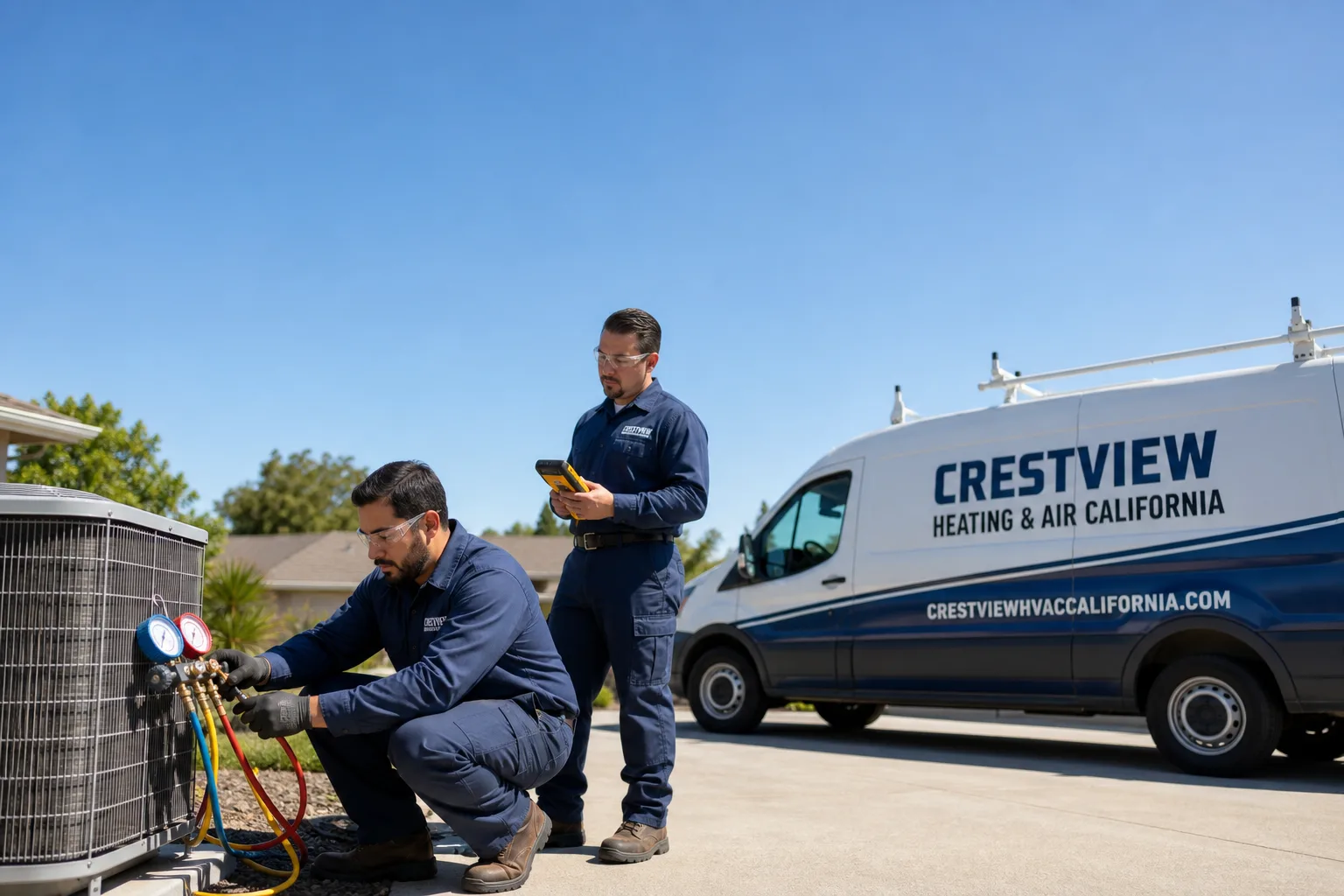
Fast, Reliable Heat Pump & Mini Split Across Antelope
Heat pump and mini split service in Antelope, CA typically runs $150 for repairs up to $7,500 for full installations, with most jobs completed in a single day. We’re Crestview Heating & Air California, and we know the 95843 ZIP well — from the tile-roofed tracts along Walerga Way to the older builds near Antelope Road. If your system is struggling through another 110°F July afternoon or your bedroom is running 10°F warmer than the thermostat reads, call us at (844) 560-6978. Our owner Marcus Feldman still manages jobs in the field, so the accountability you get isn’t outsourced to a dispatch center.
Why Crestview Heating & Air California Is Antelope’s Preferred Heat Pump & Mini Split Company
We’ve spent nearly two decades in HVAC, and that means we’ve watched Antelope’s housing stock age in real time. The 1,500–2,800 sq ft tract homes built between 1986 and 2000 — the vast majority of this community — are now hitting a concentrated replacement wave their neighbors in Citrus Heights already went through decades ago.
Our 4.8-star average across 250+ customer reviews reflects work we’ve actually done, not cherry-picked testimonials. Antelope customers specifically mention our familiarity with slab-foundation layouts and attic access constraints that slow down technicians from outside the area. We’re based in San Jose with service reach throughout the Sacramento metro, and our response time to Antelope beats the franchise outfits dispatching from Roseville or downtown Sacramento because we route directly via I-80 and don’t waste time with layered scheduling departments.
When Marcus Feldman shows up as Service Manager, he’s not making a sales pitch — he’s diagnosing why your 1995 builder-grade Goodman or Rheem is dumping cold air into a 145°F attic instead of your living room. That’s ownership-level accountability you won’t get from a commissioned tech in a branded van.
Our Heat Pump & Mini Split Services in Antelope
Heat Pump Installation
Antelope’s original heat pumps were sized for 95°F design days, not the 108–112°F extremes that have become normal. We install systems rated for genuine Sacramento Valley peak loads, with proper load calculations that account for your unconditioned attic and single-pane windows still common in 1990s builds. A typical Antelope tract home heat pump installation runs $3,500–$7,500 depending on tonnage, electrical upgrades, and whether we’re replacing failed flex duct simultaneously. Most jobs finish in one day; two if we’re running new refrigerant lines through a slab-foundation home with limited exterior penetrations.

Ductless System & Mini Split Install
For Antelope homes with no existing ductwork — or where the attic duct is too far gone to salvage — a ductless mini split eliminates the 140–150°F attic entirely. We mount the condenser outside, run refrigerant lines through a 3-inch wall penetration, and place air handlers exactly where cooling is needed. No attic losses. No flex-duct degradation. A single-zone mini split install for a typical Antelope master bedroom or converted garage starts around $3,500; multi-zone systems covering 3–4 rooms run toward the upper end of our installation range. We size these for Antelope’s real temperature swings, not coastal California mildness.

Multi-Zone System
The original 1990s Antelope tracts have one thermostat, usually in a hallway, controlling temperature for the entire house. Bedrooms west of the thermostat location bake in afternoon sun. A multi-zone mini split gives independent temperature control per room without running new duct through your attic. We regularly install Daikin and Carrier multi-zone systems in Antelope homes where parents want 72°F in the master bedroom while kids sleep comfortably at 68°F upstairs. Each zone gets its own wall-mounted or ceiling cassette unit with independent scheduling.

Heat Pump Repair
When your heat pump runs constantly but can’t hold setpoint on a 110°F Antelope afternoon, the culprit is usually one of three things we see weekly: low refrigerant from micro-leaks in corroded coils, failed capacitors from summer thermal stress, or separated flex duct dumping capacity into the attic. Our repair calls run $150–$650 depending on parts and refrigerant charge. We stock common components for Trane, Lennox, Goodman, and Rheem systems to avoid delay.

Mini Split Repair
Ductless systems fail differently than central heat pumps — clogged condensate drains from Antelope’s hard water, failed inverter boards from voltage fluctuation during SMUD summer peaks, or refrigerant leaks at flare connections that weren’t torqued properly during original install. We factory-train on all major mini split brands and carry diagnostic tools specific to inverter-driven compressors.

What happens when you call
- 1
A real person answersNo phone trees — you reach a local pro.
- 2
You get an upfront price rangeHonest numbers before anyone is dispatched.
- 3
A background-checked tech heads outLicensed & insured, dispatched right away.
- 4
You approve before work beginsNothing starts until you say go.
Trusted Brands We Service in Antelope
Your system, our specialty — that means we don’t turn away Antelope homeowners because of brand. We service and stock parts for Carrier, Trane, Lennox, Goodman, Rheem, York, Daikin, Bryant, and American Standard. For Antelope’s concentrated 1990s housing stock, Goodman and Rheem appear most frequently as original equipment, and we keep common contactors, capacitors, and refrigerant valves on hand. When we replaced that Goodman 3-ton on Walerga Way last July, we had the replacement coil in the van by 10 a.m. because we’d already diagnosed the same failure pattern on three nearby homes that same month. Factory training across nine brands means you’re never told “we don’t work on that.”
Common Heat Pump & Mini Split Problems We See in Antelope Homes
- Flex-duct collar separation in 140–150°F attics. After 25+ years of thermal cycling, the jacket material cracks and the inner liner pulls away from collar connections. Your system runs constantly but the house won’t cool because half the capacity is venting into the attic. We find this on street after street of same-vintage Antelope homes.
- Builder-grade coil corrosion and micro-leaks. The original heat pump coils in 1990s Antelope installs weren’t built for decade after decade of 105–112°F operation. Refrigerant bleeds off gradually. Capacity drops 20% before you notice, then 40% by the time you’re calling us on the hottest day of August.
- Single-stage compressors undersized for modern extremes. Your 3-ton heat pump was correct by 1995 Manual J standards. It isn’t correct for 2025 Antelope summers. The system runs non-stop, never reaches setpoint, and burns out prematurely from continuous high-load operation.
- Nonexistent zoning with poor thermostat location. One hallway thermostat controlling 2,000 sq ft on a slab foundation with western exposure bedrooms. The hallway hits 72°F while the back bedrooms sit at 82°F. No amount of “tuning” fixes a fundamental design limitation.
Pricing for Heat Pump & Mini Split in Antelope, CA
We’re straightforward about numbers because Antelope homeowners deserve to budget accurately for systems that aren’t optional in 112°F heat.
| Service | Typical Range in Antelope |
|---|---|
| Heat Pump / AC Installation | $3,500 – $7,500 |
| Heat Pump / AC Repair | $150 – $650 |
| Annual Tune-Up | $80 – $200 |
| Mini Split Install (single-zone) | $3,500 – $5,500 |
| Multi-Zone Mini Split (3–4 zones) | $5,500 – $7,500 |
| Duct Replacement (typical Antelope attic) | $1,200 – $3,000 |
What moves you within these ranges? Tonnage, SEER rating, electrical panel capacity, and whether we’re salvaging existing lineset or running new. Slab foundations in Antelope limit exterior wall penetrations, which can add labor if we need to route lines through closets or soffits. Every estimate we provide is free and itemized — no vague “plus materials” language. Call (844) 560-6978 to schedule.
We Also Serve Cities Near Antelope
Our service radius covers Foothill Farms, North Highlands, Citrus Heights, and Elverta with the same owner-managed response. The housing stock differs — Citrus Heights has more 1960s–70s builds with different duct configurations, while Elverta trends rural with larger lots and propane conversions — but our Heat Pump & Mini Split team adjusts for each area’s specific conditions. If you’re on the border between Antelope and North Highlands off Watt Avenue, we’ll route the closest available technician regardless of which side of the line you sit.
Serving Antelope, CA — Our Local Coverage Area
We’re based in the Antelope area and know this community well. Use the map below to see our service coverage — if you’re nearby, we can almost certainly help.
FAQs — Heat Pump & Mini Split in Antelope
Your system is almost certainly delivering less than half its rated capacity into the living space. In Antelope’s 1990s tract homes, the most common cause is separated flex-duct collars in 140–150°F attics — conditioned air vents directly into the attic at peak load. The second most common is gradual refrigerant loss from corroded coils that can’t transfer enough heat when ambient temperatures hit 110°F. We verify both with pressure testing and attic inspection. Call (844) 560-6978 for diagnosis — estimates are free.
Yes, if your attic duct is original and degraded. Installing new central duct in a 145°F Antelope attic means you’re building a distribution system in the worst possible environment. A ductless mini split bypasses the attic entirely, delivers 100% of its capacity to the room, and lets you zone independently. For homes with intact duct, a high-efficiency central heat pump may cost less upfront. We’ll inspect your attic and give you real numbers for both paths.
One day for straightforward swap-outs where electrical and lineset are reusable. Two days if we’re replacing failed flex duct, upgrading electrical service, or running new lines through a slab-foundation home with limited exterior access. Antelope’s uniform 1,500–2,800 sq ft layouts are predictable — we know the joist spacing, the attic hatch locations, and the panel capacities before we arrive. That predictability saves you labor hours.
Because the failure is at the collar connection above the insulation layer, not the visible duct span below. The inner liner separates from the metal collar; the outer jacket may still appear intact. You feel the tear as reduced airflow at the register, not as visible damage. In Antelope’s 1990s builds, this is epidemic — we’ve found it on entire blocks of same-vintage homes. A camera inspection confirms it without crawling through 140°F fiberglass.
Yes, if the air handler is original. Mismatched components reduce efficiency ratings, void manufacturer warranties, and often create humidity control problems in Antelope’s dry-summer climate. The indoor coil in a 1998 air handler is also corroded and likely leaking. Replacing only the outdoor unit saves maybe $1,200 upfront but costs more in energy and premature failure. We quote both options so you can see the 10-year math.
Written by Marcus Feldman, Owner at Crestview Heating & Air California, serving Antelope and the Sacramento Valley with nearly two decades of hands-on HVAC experience.