
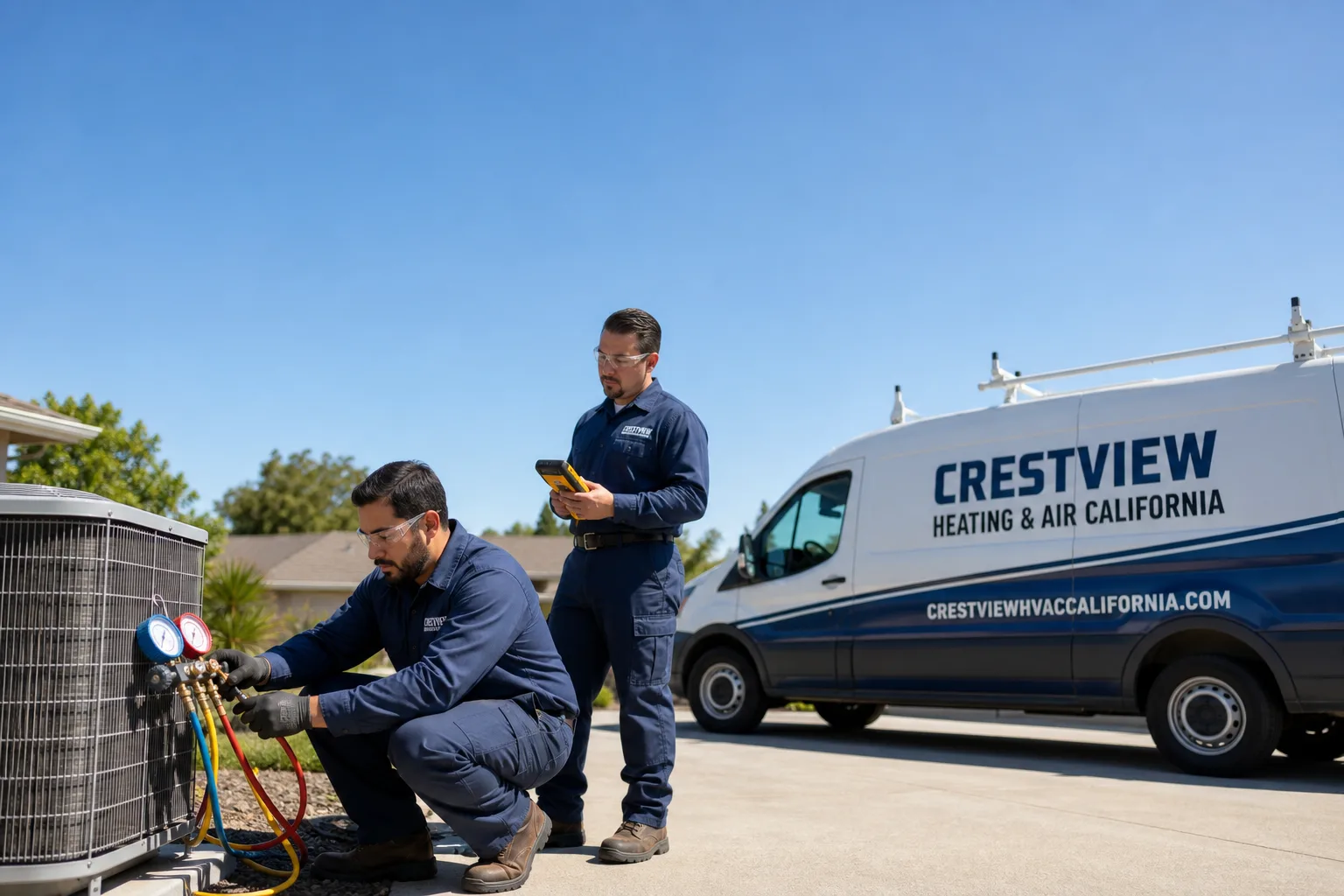
Fast, Reliable Heat Pump & Mini Split Across Petaluma
Heat pump and mini split installation in Petaluma typically runs $4,130–$8,850 for a full system, with repairs ranging $175–$765 and same-day service available for most calls. We’re Crestview Heating & Air California, and our Heat Pump & Mini Split team makes the trip up from San Jose to Petaluma regularly — usually same-day or next-morning depending on schedule. After 19 years in HVAC and 250+ reviews averaging 4.8 stars, we’ve learned that Petaluma’s mix of historic West Side homes and 1970s tract housing creates challenges no generic installer anticipates. Call (844) 560-6978 for a free estimate.
Why Crestview Heating & Air California Is Petaluma’s Preferred Heat Pump & Mini Split Company
Petaluma isn’t a market we dabble in — it’s a market we know. Owner Marcus Feldman serves as our Service Manager, which means the person answering technical questions and sizing your system is the same person with ownership stake in the outcome. No dispatch center. No rotating subcontractors.
Our 4.8-star rating across 250+ customer reviews includes plenty of Petaluma feedback, and the pattern is consistent: homeowners appreciate that we don’t treat their 1905 Victorian on D Street like a standard new construction job. We understand the Petaluma Gap’s 20–35 mph afternoon winds, the lack of ductwork in historic cores, and the undersized systems common in east-side tract homes.
Response time to Petaluma is typically same-day for emergency calls and next-morning for scheduled estimates. We’ve run linesets through attics and closets to preserve historic plaster, and we’ve replaced heat pumps in backyards where gap winds have shaken condenser fan assemblies for three seasons straight.
Our Heat Pump & Mini Split Services in Petaluma
Heat Pump Installation
Most Petaluma homes weren’t built with heat pumps in mind. West Petaluma’s Victorian and Craftsman stock from the 1880s–1920s often has no ductwork at all — just floor furnaces or gravity heat. East Petaluma’s 1970s–1990s tract homes along Ely Road and Sonoma Mountain Parkway frequently have aging single-speed furnaces and duct systems too small for modern heat pump airflow requirements. We size for the gap wind infiltration that drives higher heating loads than raw temperature would suggest. A typical heat pump installation in Petaluma runs $4,130–$8,850 depending on tonnage, electrical upgrades, and whether we’re retrofitting ductwork or going ductless.

Ductless System & Multi-Zone System
This is where Petaluma’s housing stock really shines for ductless. We retrofitted a 1908 Craftsman on D Street in West Petaluma — no ductwork, only a floor furnace. We installed a ductless multi-zone Daikin system with three wall-mounted heads, running linesets through the attic and closets to preserve the historic plaster and trim. No soffit destruction. No visible conduit on exterior walls. For homes in 94952’s historic district, this approach avoids permit complications and preserves character. Multi-zone systems let you heat the occupied rooms without conditioning empty guest bedrooms or formal parlors common in these older homes.

Heat Pump Repair
The Petaluma Gap’s persistent afternoon winds create a failure mode most techs from Santa Rosa or Napa miss: sustained 30+ mph gusts shake outdoor condenser fan assemblies until micro-switches fail. We’ve replaced dozens of these in gap-exposed backyards. Another local pattern: undersized duct systems in 1970s Ely Road tract homes cause static pressure spikes that trip heat pump high-pressure switches during cooling season. Our repairs run $175–$765 depending on component and accessibility.

Mini Split Repair
Poorly sealed envelopes in Victorian homes drive humidity infiltration during Petaluma’s damp, 40s-range winter spells. That moisture freezes on outdoor coils, triggering defrost cycles that never quite catch up. We see this in West Petaluma’s uninsulated crawl spaces and balloon-framed walls. The fix isn’t always a new mini split — sometimes it’s envelope sealing paired with a cold-climate-rated outdoor unit. Our diagnostic process checks coil temperature sensors, refrigerant charge, and defrost board logic before recommending replacement.

What happens when you call
- 1
A real person answersNo phone trees — you reach a local pro.
- 2
You get an upfront price rangeHonest numbers before anyone is dispatched.
- 3
A background-checked tech heads outLicensed & insured, dispatched right away.
- 4
You approve before work beginsNothing starts until you say go.
Trusted Brands We Service in Petaluma
We carry factory-trained compatibility across nine major brands, and for Petaluma we stock parts locally for Trane, Lennox, Goodman, and Rheem — the four brands we see most often in Sonoma County installs. That means faster turnaround when your heat pump fails during a January cold snap or a September heat dome pushes over the gap. “Your system, our specialty” isn’t a slogan; it’s why we don’t turn away calls for older or less-common equipment. If you’ve got a Daikin ductless system in a historic district retrofit or a Bryant heat pump in a 1980s tract home, we’ve worked on it.
Common Heat Pump & Mini Split Problems We See in Petaluma Homes
- Gap-wind condenser damage. Mini-split condensers in gap-exposed backyards suffer micro-switch failures from sustained 30+ mph winds shaking the fan assembly down over a few seasons. We check mounting stability and fan balance on every service call.
- High-pressure switch trips in undersized duct systems. 1970s tract homes on Ely Road and Sonoma Mountain Parkway were built with furnaces that didn’t care about static pressure. Modern heat pumps do. We measure total external static pressure before blaming the compressor.
- Outdoor coil freeze in damp winter conditions. Poorly sealed Victorian envelopes let humidity infiltrate during 40°F damp spells, coating mini-split coils in ice. The root cause is often crawl space ventilation, not the unit itself.
- Backdrafting from negative pressure. The Petaluma Gap’s persistent afternoon winds create enough sustained negative pressure on windward faces that atmospheric-vent furnaces and water heaters in east-facing or open-exposure properties backdraft far more readily than in calmer surrounding cities. This is a failure mode experienced Petaluma techs check first on any no-heat or CO call in gap-exposed eastern zip codes like 94954.
Pricing for Heat Pump & Mini Split in Petaluma, CA
Here’s what Petaluma homeowners actually pay:
| Service | Typical Range in Petaluma |
|---|---|
| Heat Pump / Mini Split Repair | $175–$765 |
| Heat Pump / Mini Split Installation | $4,130–$8,850 |
| Tune-Up / Maintenance | $95–$235 |
Installation costs vary with electrical panel capacity, whether we’re running new linesets through finished spaces, and if historic district permits apply in 94952. Repair costs depend on refrigerant type, part availability, and whether the unit is on a roof or in a wind-exposed location requiring extra labor for safe access. We provide upfront pricing before any work begins, and estimates are always free. Call (844) 560-6978 to schedule.
We Also Serve Cities Near Petaluma
Our service radius from San Jose covers Cotati, Rohnert Park, Sonoma, and Boyes Hot Springs regularly. If you’re in a neighboring community and found this page searching Petaluma, we likely serve your area too — call to confirm.
Serving Petaluma, CA — Our Local Coverage Area
We’re based in the Petaluma area and know this community well. Use the map below to see our service coverage — if you’re nearby, we can almost certainly help.
FAQs — Heat Pump & Mini Split in Petaluma
Yes, if it’s properly sized and installed with envelope considerations. Cold-climate mini splits from manufacturers like Daikin and Mitsubishi operate efficiently down to 5°F, well below Petaluma’s typical winter lows. The real issue is humidity infiltration from poorly sealed Victorian envelopes causing coil freeze at 40°F. We address this by checking crawl space ventilation and wall sealing during installation, not just hanging the indoor head. Call (844) 560-6978 for a free assessment of your home’s specific conditions.
A heat pump eliminates combustion entirely, so backdrafting becomes irrelevant. If you’re experiencing CO alarms or pilot light outages in an east-facing home in 94954, switching to a heat pump or ductless system removes the atmospheric venting that gap winds disrupt. We regularly recommend this conversion for gap-exposed properties where furnace replacement would still leave a backdraft risk. Owner Marcus Feldman evaluates each home’s exposure and pressure dynamics personally.
Most exterior modifications in Petaluma’s historic districts require design review, but interior ductless installations with concealed linesets often qualify as minor work. We handle permit research as part of our pre-installation survey and have worked with Petaluma’s planning staff on previous historic retrofits. The 1908 Craftsman on D Street we mentioned required no exterior visible equipment — a strategy we replicate when design review timelines would delay your project.
The gap wind’s persistent velocity strips standard insulation more aggressively than in sheltered locations, and the marine air’s higher moisture content increases condensation risk on cold refrigerant lines. We use thicker armaflex insulation and secure it with UV-rated tape on any exterior runs, particularly on north and west exposures that see the strongest afternoon flow. This prevents efficiency loss and water damage to siding over time.
Trane and Lennox both make heat pumps with variable-speed compressors that tolerate the static pressure of undersized duct systems better than single-stage units. For a 1970s Ely Road or Sonoma Mountain Parkway home, we typically recommend a two-stage or fully variable system that can ramp down when airflow is restricted, rather than tripping high-pressure limits. The specific model depends on your ductwork’s measured static pressure and electrical panel capacity. Call (844) 560-6978 and we’ll test both on-site.
Written by Marcus Feldman, Owner at Crestview Heating & Air California, serving Petaluma and the Bay Area since 2005.