
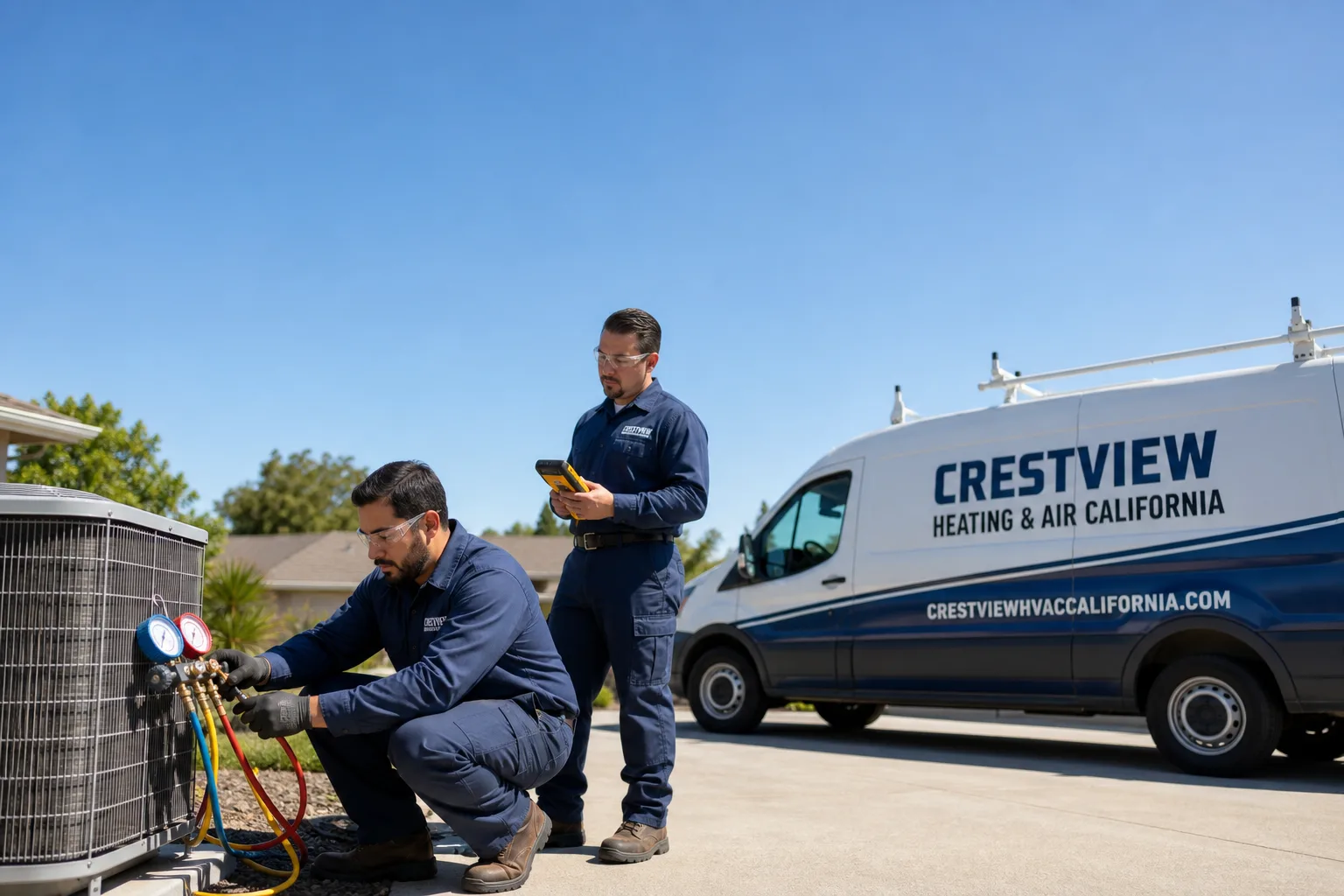
Fast, Reliable Air Quality & Ventilation Across Big Bear City
Air quality and ventilation work in Big Bear City isn’t like the flatland jobs most HVAC companies handle. At 6,750 feet, with winter lows in the single digits and 60+ inches of snow sealing homes tight for months, your cabin needs systems designed for thin air and extreme diurnal swings. We’re Crestview Heating & Air California, and our Air Quality & Ventilation team makes the drive up the mountain because Big Bear City homeowners deserve technicians who understand altitude deration, propane combustion in A-frames, and why a Friday evening furnace failure isn’t just uncomfortable — it’s a air-quality emergency when you’re opening windows at 10°F to clear fumes. Call us at (844) 560-6978 for a free estimate.
Why Crestview Heating & Air California Is Big Bear City’s Preferred Air Quality & Ventilation Company
We’ve spent nearly two decades in HVAC, and that includes enough mountain jobs to know the difference between a valley tune-up and Big Bear City reality. Owner Marcus Feldman still serves as Service Manager, which means when you call Crestview, you’re getting ownership-level accountability on every job — not a rotating subcontractor who googles “high-altitude orifice kit” in your driveway.
Our 4.8-star average across 250+ customer reviews reflects work done right the first time, including mountain customers who’ve watched out-of-area crews botch deration and leave them with soot-stained ceilings. We carry parts for Trane, Lennox, Goodman, and Rheem systems specifically because Big Bear City’s older housing stock means we see furnaces from the 1980s still running alongside newer installs. Your system, our specialty — and we don’t leave the mountain until combustion tests clean.
We schedule around Big Bear City’s predictable Friday-evening surge, when weekenders arrive to cold cabins and push dormant furnaces to their limit. That local rhythm matters for response planning.
Our Air Quality & Ventilation Services in Big Bear City
ERV & HRV System Installation
Big Bear City’s 60+ inches of annual snow and single-digit winters force homeowners to seal every crack, but a tight cabin without mechanical ventilation becomes a CO and humidity trap. An Energy Recovery Ventilator (ERV) or Heat Recovery Ventilator (HRV) brings in fresh outdoor air while pre-warming it with exhaust heat — critical when opening a window means losing 20 degrees in twenty minutes. At that 1960s A-frame on Pine Knot Trail, we found the original gravity furnace had never been fitted with a high-altitude orifice kit, causing chronic sooting. We replaced it with a derated Carrier gas furnace and added a whole-house ERV to manage the snow-sealed winter envelope — now the family can breathe without opening a window in single-digit temps. ERV/HRV installation in Big Bear City typically runs $3,500–$7,500 depending on existing ductwork accessibility and whether your cabin’s crawlspace can accommodate the unit.

Whole-House Humidifier Installation
Big Bear City’s winter air is already thin from altitude; heated indoor air drops to Sahara-level humidity, cracking woodwork, amplifying static, and drying sinus membranes that are your first defense against winter illness. Whole-house humidifier installation in Big Bear City runs $150–$700, with steam units on the higher end for larger A-frames and bypass systems sufficient for smaller converted cabins. We size these to your furnace’s derated output, not the manufacturer’s valley spec, because an oversized humidifier on an undersized mountain furnace creates condensation in ductwork that freezes in uninsulated crawlspaces. Marcus has seen this exact failure pattern in 1970s wood-frames near Sugarloaf Boulevard.

Air Filtration Systems
Older Big Bear City cabins pull return air through crawlspaces that often contain rodent debris, mold, and in worst cases, exhaust from backdrafting flues. Standard 1-inch furnace filters won’t stop PM2.5 or volatile combustion byproducts. We install 4-inch and 5-inch media filters, electronic air cleaners, and cabinet-style HEPA systems sized to your actual airflow — which, at altitude, is lower than the nameplate rating. For the 1950s–1970s housing stock that dominates ZIP 92314, we always test static pressure before recommending filtration upgrades; too much restriction on an already derated system causes heat exchanger stress and the very sooting you’re trying to avoid.

UV Air Purifier Installation
Big Bear City’s vacation cabin cycle — heated hard Friday through Sunday, then left cold and damp Monday through Thursday — creates ideal mold growth conditions in crawlspace ductwork. UV-C lamps mounted at the evaporator coil or in the return plenum kill mold spores before they circulate. We install these as standalone upgrades or paired with filtration systems, with lamp replacement schedules adjusted for the shorter heating season intensity (Big Bear City furnaces run fewer total hours than valley systems, but work harder per hour).

Dehumidifier Installation
Summer in Big Bear City is brief, but the extreme diurnal temperature swings — 35–45°F between night and day — mean morning condensation in poorly insulated wall cavities. Whole-house dehumidifiers tied to your central system prevent the musty smell that greets weekenders in July and August, and protect the same wood-frame structures that struggle with winter dryness.

Ventilation System Installation & Repair
From bathroom exhaust upgrades to whole-house make-up air for tight mountain envelopes, we design ventilation that accounts for Big Bear City’s altitude-specific combustion air requirements. Code here is stricter than valley jurisdictions, and inspectors know the difference between a properly derated installation and a dangerous guess.

What happens when you call
- 1
A real person answersNo phone trees — you reach a local pro.
- 2
You get an upfront price rangeHonest numbers before anyone is dispatched.
- 3
A background-checked tech heads outLicensed & insured, dispatched right away.
- 4
You approve before work beginsNothing starts until you say go.
Trusted Brands We Service in Big Bear City
We stock parts and filters for Carrier, Trane, Lennox, Goodman, Rheem, York, Daikin, Bryant, and American Standard — the full nine-brand lineup — because Big Bear City’s mixed-age housing means we never know what we’ll find behind that cabin’s utility door. Marcus keeps high-altitude orifice kits for Goodman and Rheem furnaces on the truck, along with ERV core replacements for common Lennox and Trane units. That inventory saves Big Bear City customers a second trip charge when the part they need isn’t a valley-standard SKU. Your system, our specialty — and we don’t special-order what we should already carry.
Common Air Quality & Ventilation Problems We See in Big Bear City Homes
- Propane systems undersized for uninsulated 1970s A-frames. When the furnace can’t reach setpoint, it runs continuously, depressurizing the home and pulling exhaust back down the flue. Inadequate ventilation makes this a CO hazard, not just a comfort complaint. We see this pattern repeatedly in converted vacation cabins near the Moonridge area.
- Vacation cabins left unheated Monday through Thursday accumulate stale, damp air. When owners arrive Friday and crank the thermostat, that moisture load hits the ductwork, triggering mold growth in crawlspaces that have been cold-soaked all week. The first breath of “cabin smell” is often microbial, not rustic charm.
- Poorly sealed crawlspace ductwork pulls in cold air and flue exhaust. In Big Bear City’s wood-frame legacy housing, return plenums with gaps near the furnace closet recirculate combustion byproducts and rodent debris. We test with a smoke pencil and seal with mastic, not duct tape that fails at altitude temperature extremes.
- Extreme diurnal temperature swings stress flue seals and reversing valves. Big Bear City’s 35–45°F daily temperature swings — rare in valley cities — repeatedly expand and contract furnace flue gaskets, creating CO leaks, and cycle heat pump reversing valves through thermal shock that valley technicians misdiagnose as “normal wear.”
Pricing for Air Quality & Ventilation in Big Bear City, CA
Mountain HVAC work costs more than valley jobs for legitimate reasons: travel time, altitude-specific parts, and the liability of combustion work where a mistake means freezing pipes or worse. Here’s what we typically see in Big Bear City:
| Service | Typical Range in Big Bear City |
|---|---|
| ERV/HRV Installation | $3,500–$7,500 |
| Whole-House Humidifier Installation | $150–$700 |
| UV Air Purifier Installation | $400–$1,200 |
| Media Air Cleaner (4–5 inch) Upgrade | $300–$900 |
| Duct Sealing & Ventilation Repair | $500–$2,500 |
These ranges assume typical 1950s–1970s Big Bear City construction with accessible crawlspaces. A-frames with finished basements or additions with no existing duct access run higher. We provide exact quotes after inspection — estimates are free, and we don’t pressure for same-day decisions. Call (844) 560-6978 to schedule.
We Also Serve Cities Near Big Bear City
Our mountain coverage extends to Big Bear Lake for lakeside cabin work, Lucerne Valley for high-desert altitude jobs, and down the hill to Yucaipa and Mentone for customers with second homes in both zones. Each microclimate has distinct ventilation requirements; we adjust for elevation and housing age, not just mileage.
Serving Big Bear City, CA — Our Local Coverage Area
We’re based in the Big Bear City area and know this community well. Use the map below to see our service coverage — if you’re nearby, we can almost certainly help.
FAQs — Air Quality & Ventilation in Big Bear City
Yes, if your cabin is sealed tight for winter snow loads and you can’t open windows without losing heat. An ERV preserves humidity and pre-warms incoming air; an HRV transfers only heat and is better for very tight, already-humid spaces. Most Big Bear City wood-frame cabins benefit from ERVs given the extreme dryness of heated mountain air. Call (844) 560-6978 and we’ll test your envelope to recommend the right unit.
Your furnace likely wasn’t derated for 6,750-foot altitude, meaning it receives too much fuel for the available oxygen and burns incompletely. This is a manufacturer and code requirement that valley technicians routinely miss. The fix is a high-altitude orifice kit and combustion adjustment, not just a cleaning. We see this on original gravity furnaces and newer installs alike — call for a combustion analysis before the problem worsens.
When a cabin sits cold all week, moisture condenses in ductwork and combustion appliances. Firing everything to maximum Friday evening stirs mold spores, stresses heat exchangers, and can backdraft flues if the house is too tight. The result is a weekend of headaches, burning eyes, and that “cabin smell” that isn’t normal. Pre-arrival thermostat scheduling and proper ventilation prevent this pattern.
Yes, if you spend more than occasional weekends here and want to protect woodwork, reduce static, and maintain healthy mucous membranes in altitude-dry air. Whole-house units integrate with your furnace and cost $150–$700 installed. Skip portable units that grow bacteria in mountain temperature swings and can’t serve the whole A-frame.
UV-C lamps kill mold spores at the coil and in the airstream, but they don’t remove dead spores or fix the moisture source. In Big Bear City’s vacation cabin cycle, we recommend UV paired with dehumidification or ERV ventilation — otherwise you’re treating symptoms while Monday-through-Thursday dampness keeps growing new mold. Call (844) 560-6978 for a duct inspection and combined solution.
Written by Marcus Feldman, Owner at Crestview Heating & Air California, serving Big Bear City and the San Bernardino Mountains with owner-managed HVAC service since 2005.