
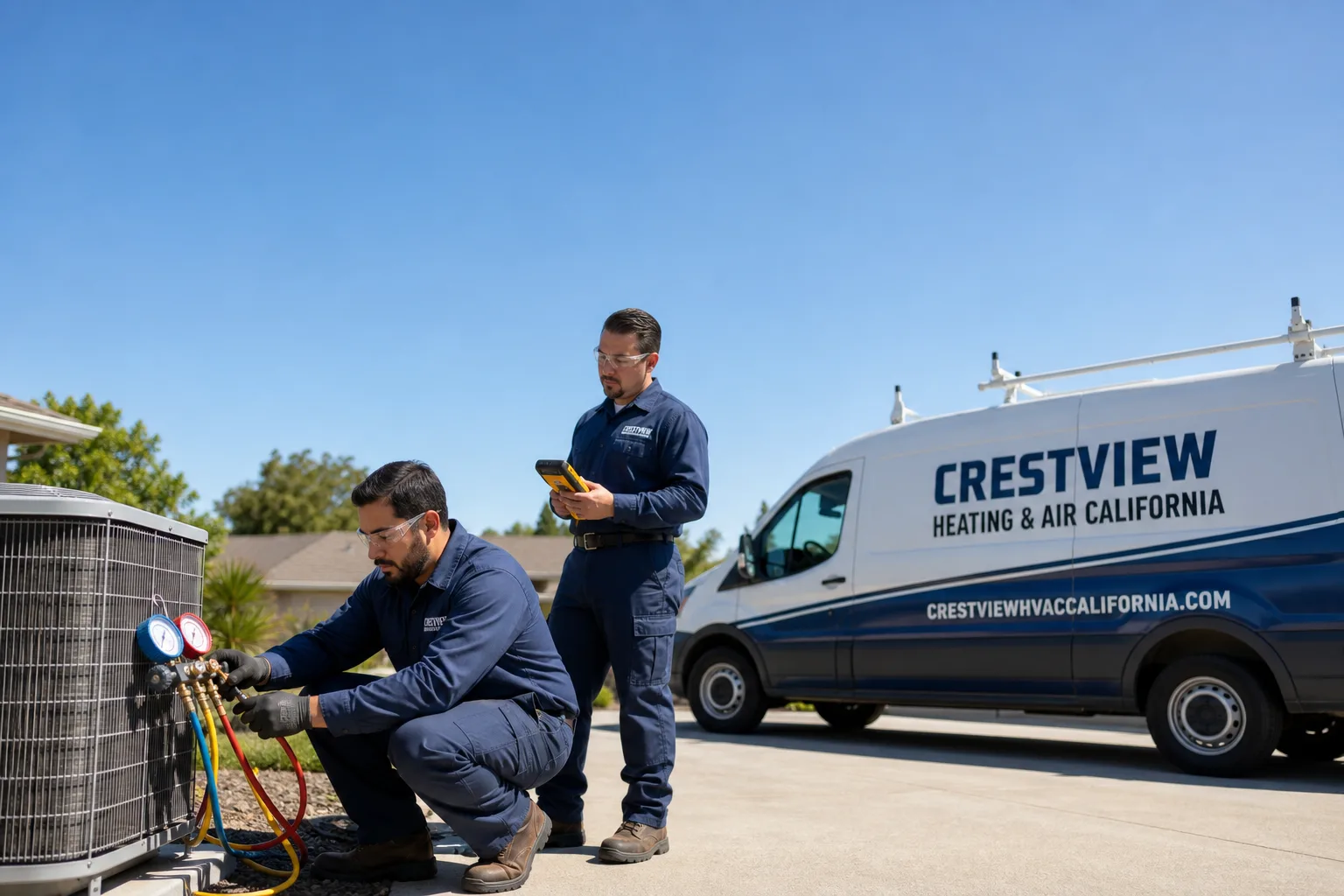
Fast, Reliable Emergency & Commercial HVAC Across Apple Valley
When your heat pump’s auxiliary strips burn out on a 17°F January night or your aging evaporative cooler quits during a 108°F July afternoon, you need an HVAC team that understands Apple Valley’s brutal dual-extreme climate. We’re Crestview Heating & Air California, and we make the drive from our San Jose base to serve Apple Valley property owners who can’t wait for a fix. Call us at (844) 560-6978 — we answer emergency calls personally, and we’ve spent nearly two decades troubleshooting the exact systems found in Victor Valley homes and businesses.
Apple Valley isn’t like other Southern California markets. At roughly 2,900 feet in the Mojave High Desert, this town breaks thermometers in both directions. Summer highs crush 105°F regularly from June through September. Winter nights plunge below 20°F in January. That puts unique stress on HVAC equipment — especially the heat pumps and evaporative coolers that dominate local properties built during the 1980s and 1990s growth surge. Our Emergency & Commercial HVAC team has replaced burned heat strips on Navajo Road, converted failed swamp coolers to central AC near Bear Valley Road, and cleaned silt-packed condenser coils for commercial clients along Highway 18. We know what fails here, and we know why.
Why Crestview Heating & Air California Is Apple Valley’s Preferred Emergency & Commercial HVAC Company
Our reputation in Apple Valley is built on showing up when the big franchises won’t. Owner Marcus Feldman serves as our Service Manager, which means the person answering your emergency call has 19 years of field experience and direct accountability for every repair. We’re not a dispatch center sending whoever’s available. Marcus reviews each job, and that ownership-level involvement shows in our 4.8-star average across 250+ customer reviews.
Apple Valley customers specifically mention our response to extreme-weather emergencies in their feedback. When temperatures spike past 105°F, evaporative cooler failures cascade across the Victor Valley — we’ve handled multiple same-day conversion calls in the 92307 and 92308 zip codes. When hard freezes hit, our crew knows which neighborhoods built out in the 1980s have original heat pumps with undersized auxiliary heat strips that simply can’t keep up.
We’re also factory-trained across nine major brands: Carrier, Trane, Lennox, Goodman, Rheem, York, Daikin, Bryant, and American Standard. In Apple Valley, that matters more than you might think. Many local homes still run original Carrier or Trane systems from the tract-home boom, and commercial properties along Apple Valley Road rely on Lennox or Rheem rooftop units. We don’t tell you “we don’t work on that.” Your system, our specialty.
From emergency calls to commercial buildouts, we bring the same owner-managed approach. Marcus still handles field diagnostics personally on complex jobs. That’s the difference between a company with skin in the game and one that’s outsourced your comfort to a subcontractor.
Our Emergency & Commercial HVAC Services in Apple Valley
24/7 Emergency HVAC
Apple Valley’s dual-extreme climate doesn’t follow business hours. We’ve taken emergency calls at 11 PM when a heat pump’s auxiliary strips failed during a January freeze below 20°F — a failure mode that barely exists in lower-elevation Inland Empire markets. Our crew responded to one such call on Navajo Road where an aging Carrier heat pump on a 1980s tract home had its auxiliary heat strip burn out completely. We replaced the heat strips and retrofitted a new thermostat to manage the auxiliary load, restoring warmth before pipes could burst. Summer emergencies are just as critical: when temperatures exceed 105°F, evaporative coolers installed in the 1980s–1990s fail entirely, leaving families with no cooling whatsoever. We handle same-day conversions to central AC when the situation demands it.

Commercial HVAC
Apple Valley’s commercial corridor along Highway 18 and near the Jess Ranch Marketplace depends on reliable climate control for retail, office, and light industrial tenants. We’ve serviced split systems and packaged units for property managers who can’t afford tenant complaints or inventory damage. Our commercial work includes load calculations for spaces that were originally built with evaporative cooling — a common scenario in older Apple Valley commercial properties — and retrofitting central AC systems that can actually handle 110°F days. We understand the permitting context in San Bernardino County and coordinate with local inspectors when equipment upgrades require sign-off.

Rooftop Unit Service
Commercial rooftop units in Apple Valley face a specific enemy: Mojave wind events that pack condenser coils with fine desert silt and sand each spring. This isn’t a theoretical concern. We’ve tracked a predictable wave of high-head-pressure shutdowns across Apple Valley commercial properties every April and May, right when businesses need cooling most. Our rooftop unit service includes deep coil cleaning, refrigerant charge verification, and electrical connection inspection — maintenance that prevents the seasonal failure pattern our competitors in Riverside or San Bernardino rarely encounter. For properties near the open desert or along Bear Valley Road where wind exposure is highest, we recommend pre-season inspections that specifically target coil blockage.

Annual Maintenance
Annual maintenance in Apple Valley isn’t a luxury — it’s survival planning for equipment that works harder than almost anywhere in California. Our maintenance program addresses the specific wear patterns we see in Victor Valley systems: heat pump auxiliary strip testing before winter freezes, evaporative cooler scale inspection from hard groundwater, and condenser coil cleaning before spring wind events. For commercial clients with rooftop units, we schedule maintenance visits in March and October to bracket the extreme seasons. Residential customers in neighborhoods like Spring Valley Lake and the older tracts near Central Road benefit from pre-season tune-ups that catch the problems Apple Valley’s climate creates. A typical tune-up in Apple Valley runs $80–$200.

HVAC Inspection
Property transactions in Apple Valley’s 92307 and 92308 zip codes often reveal HVAC systems that haven’t kept pace with the climate. We perform detailed inspections for buyers and sellers, documenting the critical issues that high-desert living creates: auxiliary heat capacity, duct insulation levels in 140°F attics, and evaporative cooler condition for properties still running legacy swamp cooling. Our inspection reports include realistic replacement timelines and cost estimates based on actual Apple Valley market pricing.

What happens when you call
- 1
A real person answersNo phone trees — you reach a local pro.
- 2
You get an upfront price rangeHonest numbers before anyone is dispatched.
- 3
A background-checked tech heads outLicensed & insured, dispatched right away.
- 4
You approve before work beginsNothing starts until you say go.
Trusted Brands We Service in Apple Valley
We stock parts and maintain factory-trained expertise across Carrier, Trane, Lennox, Goodman, Rheem, York, Daikin, Bryant, and American Standard — the nine brands that cover virtually every system installed in Apple Valley since the 1980s. Many local homes still run original Carrier heat pumps from the tract-home boom, and we’ve replaced more Goodman and Rheem condensers in recent years as property owners upgrade from failed evaporative coolers. For commercial clients, Trane and Lennox rooftop units dominate the Highway 18 corridor, and we carry common capacitors, contactors, and control boards to minimize downtime. We don’t make you wait for a parts order from San Bernardino. Our truck inventory and supplier relationships mean most Apple Valley repairs complete in a single visit.
Common Emergency & Commercial HVAC Problems We See in Apple Valley Homes
- Evaporative cooler failure above 105°F. Swamp coolers installed during the 1980s–1990s Apple Valley build-out scale rapidly from Victor Valley’s hard groundwater and lose effectiveness as temperatures climb. When the mercury crosses 105°F — common from June through September — these units fail completely, driving emergency conversion calls to central AC that coastal markets never see.
- Heat pump auxiliary strip burnout during hard freezes. Apple Valley’s winter nights below 20°F push auxiliary heat systems past their design limits, especially in original 1980s equipment that was undersized even for the construction standards of that era. We replace burned strips and upgrade thermostats to manage load cycling.
- Spring condenser coil shutdowns from desert silt. Mojave wind events pack outdoor coils with fine sand that restricts airflow and triggers high-head-pressure safety shutdowns. This predictable seasonal pattern hits Apple Valley harder than lower-elevation markets because of sustained wind exposure and fine particulate composition.
- Ductwork degradation in superheated attics. Original ductwork in 1980s–early 2000s Apple Valley tract homes runs through attics that exceed 140–150°F in summer, accelerating seal failure and insulation collapse. We find 20–30% conditioned air loss in these systems during inspections.
Pricing for Emergency & Commercial HVAC in Apple Valley, CA
We believe Apple Valley customers deserve upfront numbers, not vague “call for estimate” runarounds. Here’s what typical services run in our Apple Valley market:
| Service | Typical Range in Apple Valley |
|---|---|
| AC Repair | $150–$650 |
| Furnace Repair | $150–$700 |
| AC Installation | $3,500–$7,500 |
| Tune-Up / Maintenance | $80–$200 |
What moves you within these ranges? System age and accessibility matter. A 1980s Carrier heat pump in an Apple Valley attic with limited access takes longer to diagnose than a newer ground-level unit. Parts availability for discontinued models can add cost — though our multi-brand inventory minimizes this. Emergency calls outside standard hours carry additional trip charges, which we disclose before dispatch. Commercial rooftop unit pricing depends on unit tonnage and whether crane access is required.
The best way to get your exact number? Call (844) 560-6978 for a free estimate. We’ll ask the right questions about your system, your property, and your timeline, then give you a firm quote with no pressure.
We Also Serve Cities Near Apple Valley
Our service radius covers the full Victor Valley and surrounding high-desert communities. We regularly make calls to Spring Valley Lake for lake-adjacent properties with unique humidity considerations, Victorville for commercial clients along the I-15 corridor, Hesperia for hillside homes with different wind exposure, and Oak Hills for rural properties on larger parcels with specialized equipment needs. Whether you’re in Apple Valley proper or nearby, our Emergency & Commercial HVAC team brings the same owner-managed approach.
Serving Apple Valley, CA — Our Local Coverage Area
We’re based in the Apple Valley area and know this community well. Use the map below to see our service coverage — if you’re nearby, we can almost certainly help.
FAQs — Emergency & Commercial HVAC in Apple Valley
They fail for different reasons that coincide above 105°F. Your evaporative cooler loses effectiveness because extreme heat overwhelms its capacity to drop air temperature through water evaporation, and years of scale buildup from Victor Valley’s hard groundwater further reduce output. Meanwhile, your central AC works at maximum load for extended periods, stressing capacitors, contactors, and compressors that may already be weakened by previous seasons. The combination creates a cascade of failures we see every July in Apple Valley. If your cooler is original to a 1980s–1990s home, replacement rather than repair is usually the practical choice. Call (844) 560-6978 for a free assessment of your specific system.
Yes, and it’s the most likely cause when Apple Valley temperatures drop below 20°F. Heat pumps lose efficiency as outdoor temperature falls, and below roughly 35°F they rely on electric auxiliary heat strips to maintain indoor temperature. Original equipment in 1980s Apple Valley tract homes often has undersized strips that simply can’t handle sustained demand during hard freezes. The strips overheat and burn out, or the sequencer that controls them fails from repeated cycling. Our crew replaced burned strips on Navajo Road during exactly this scenario. We also check whether your thermostat is properly configured to stage auxiliary heat — poor sequencing accelerates failure. Call (844) 560-6978 and we’ll diagnose whether you need strip replacement, thermostat upgrade, or full system resizing.
Twice yearly: once in March before spring wind events pack coils with desert silt, and once in September after the heavy cooling season. For properties near open desert or along high-wind corridors like Bear Valley Road, quarterly cleaning may be warranted. The fine sand that blows through the Victor Valley lodges deep in coil fins where standard maintenance won’t reach it. We’ve seen commercial units lose 30% efficiency from coil blockage alone. Our maintenance agreements include priority scheduling for these critical pre-season cleanings. Call (844) 560-6978 to set up a schedule that matches your property’s exposure.
Yes, through several channels. Southern California Edison offers commercial rebates for high-efficiency central AC and heat pump installations that replace evaporative cooling, with specific programs for small business customers. San Bernardino County property tax assessments may also benefit from energy efficiency improvements, though the exact structure varies by district. We help Apple Valley commercial clients navigate available programs during the quoting process, and we spec equipment that qualifies for maximum incentives. The conversion itself typically pays back through reduced water usage — evaporative coolers consume significant gallons in Apple Valley’s dry climate — and improved tenant comfort that reduces vacancy. Call (844) 560-6978 for a free estimate that includes incentive guidance.
Three critical items: heat exchanger inspection for cracks that could leak carbon monoxide when the unit switches to heating mode, defrost control verification to prevent ice buildup on coils during cold nights, and auxiliary heat strip testing to confirm they’ll carry the load when temperatures drop below 20°F. We also check economizer dampers, which can stick open and freeze supply air in winter. Apple Valley’s hard freezes are genuine — not the mild lows that coastal commercial HVAC technicians encounter. Our pre-winter inspections catch the failure modes that matter in this climate. Call (844) 560-6978 to schedule before January cold arrives.
Ready to solve your Apple Valley HVAC problem? Whether it’s an emergency heat pump failure on a freezing night, a commercial rooftop unit that quit in July, or a legacy evaporative cooler that finally gave up, Crestview Heating & Air California brings nearly two decades of hands-on experience to your door. Owner Marcus Feldman oversees every job as Service Manager, and our 250+ customers who left reviews agree — this is owner-managed service, not outsourced dispatch. Call (844) 560-6978 now for your free estimate.
Written by Marcus Feldman, Owner at Crestview Heating & Air California, serving Apple Valley since 2005.