
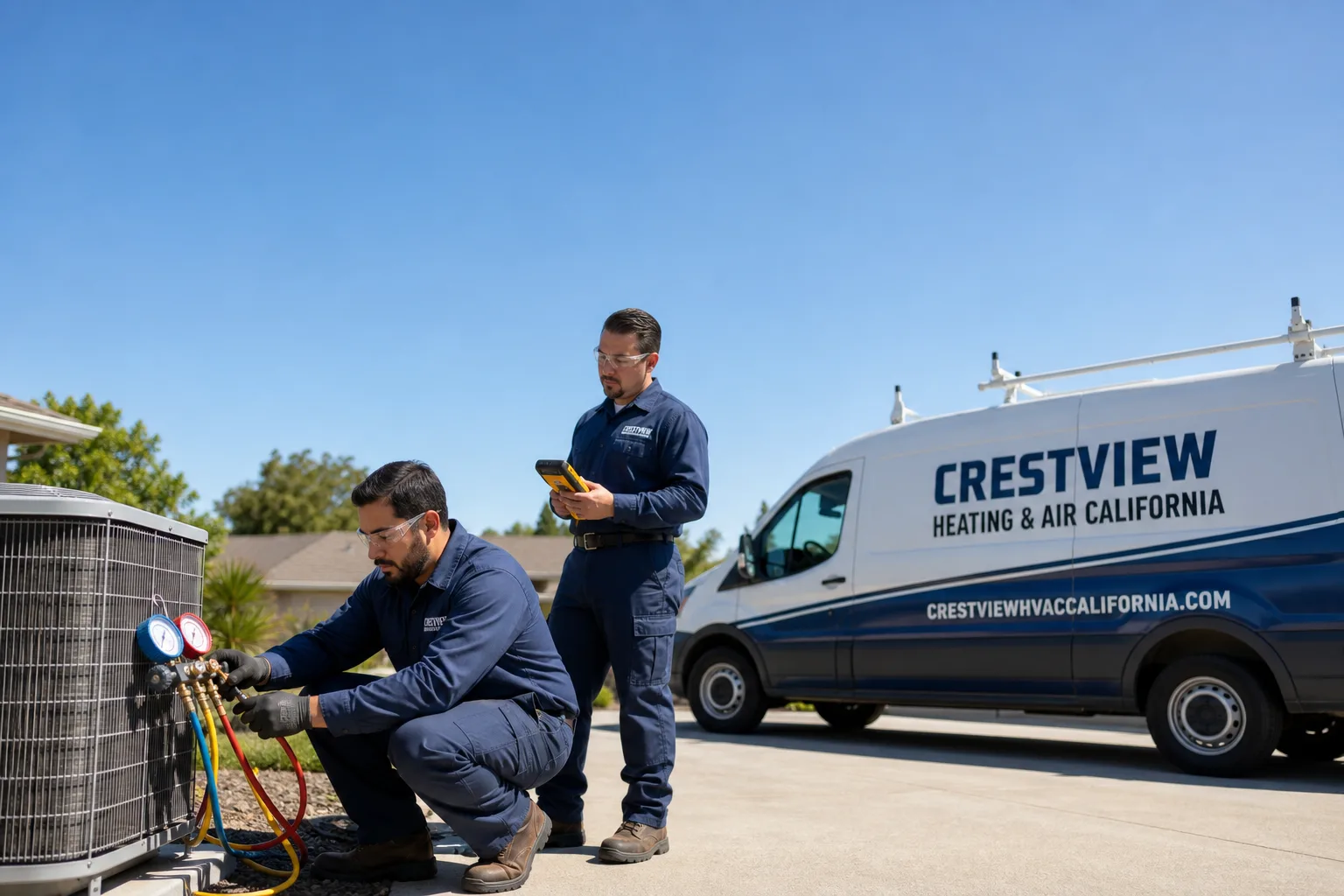
Fast, Reliable Emergency & Commercial HVAC Across Chinatown
When your wall heater dies on a foggy January night or your mini-split stops pushing warm air through a single-room occupancy unit on Stockton Street, you need an HVAC crew that understands Chinatown’s buildings, not a dispatcher reading from a script. We’re Crestview Heating & Air California, and our Emergency & Commercial HVAC team has been handling heating failures in San Francisco’s densest, oldest neighborhood for nearly two decades. Call us at (844) 560-6978 — we know the 94133 ZIP’s permit rules, its shared-facade logistics, and why a standard suburban repair approach won’t work here.
Why Crestview Heating & Air California Is Chinatown’s Preferred Emergency & Commercial HVAC Company
Our 4.8-star average across 250+ customer reviews reflects real jobs in real buildings — not curated testimonials from easy suburban installs. Chinatown property managers and building owners call us back because we’ve proven we can thread a lineset through a brick party wall on Jackson Street without damaging the facade, and because we know which emergency permits the Department of Building Inspection will issue same-day versus which require a historic-preservation review.
Owner Marcus Feldman serves as our Service Manager, so when you call Crestview, you’re talking to someone with ownership-level accountability who still manages jobs in the field. That matters in Chinatown, where a midnight no-heat call on Washington Street might involve coordinating with three neighboring property owners just to access a shared wall cavity. We’re not a franchise dispatching anonymous technicians. We’re owner-managed, not outsourced.
Our 19 years of HVAC experience means we’ve worked on virtually every system type found in post-1906 Chinatown buildings: original wall heaters from defunct manufacturers, first-generation ductless heads, and modern mini-splits retrofit into spaces that were never designed for mechanical systems. Your system, our specialty — even when “your system” is 60 years old and the manufacturer went out of business in 1987.
Our Emergency & Commercial HVAC Services in Chinatown
24/7 Emergency HVAC
Emergency calls in Chinatown follow a different pattern than the rest of San Francisco. Because the 94133 ZIP sits in one of the coolest summer microclimates in the continental U.S., with marine fog keeping July afternoons below 65°F, our emergency dispatch is almost exclusively heating failures from October through May. We responded to a midnight no-heat call on Washington Street where a 40-year-old wall heater in a single-room occupancy unit had seized. Our crew found the gas valve from a model no longer made, so we retrofitted a new ductless mini-split head unit, threading the lineset through a brick party wall and obtaining a same-day emergency permit from the Department of Building Inspection — the unit was heating by 7 a.m. That’s the difference between a technician who knows Chinatown and one who’d still be searching for obsolete parts.

Commercial HVAC
Chinatown’s commercial HVAC work happens in buildings with ground-floor restaurants and shops beneath dense residential units, all sharing party walls and featuring floor-to-floor heights so shallow that standard ductwork is physically impossible. We service rooftop units on the few buildings with accessible roofs, but more often we’re designing zoned mini-split solutions for mixed-use properties on Grant Avenue or Sacramento Street. Our commercial clients include small restaurant owners, property management companies handling SRO buildings, and retail operators who need heating that won’t trigger a historic-facade violation. From emergency calls to commercial buildouts, we scale to the job.

Rooftop Unit Service
The limited rooftop access in Chinatown’s 3-to-6-story buildings means rooftop units are rarer here than in suburban commercial zones, but where they exist — typically on newer infill structures near the neighborhood’s edges — they require specialized knowledge of marine-climate corrosion and the salt-laden bay air that accelerates coil degradation. We service Trane, Lennox, and Rheem RTUs with factory-trained protocols, and we stock replacement components locally so a failed compressor doesn’t shut down your business for a week.

Annual Maintenance
Annual maintenance in Chinatown isn’t a luxury — it’s survival planning for heating systems that run hard through damp, 50°F winter nights. Our maintenance visits focus on wall heater combustion safety, mini-split line insulation integrity, and condensate drainage in shallow cavities where fog-driven moisture accumulates. We catch the cracked heat exchangers and deteriorating gas valves that cause midnight emergencies, and we document system condition for property managers who need to plan capital replacements around tenant turnover.

Chiller Service
While true chiller systems are uncommon in Chinatown’s smaller commercial buildings, we do service compact chilled-water systems in a few larger mixed-use properties near Portsmouth Square. These systems face the same marine-corrosion challenges as coastal equipment everywhere, but with the added complexity of shared mechanical rooms and restricted access for crane or rigging operations. Our 19 years of experience includes chiller diagnostics and repairs that minimize disruption to ground-floor businesses.

HVAC Inspection
Pre-purchase and pre-lease HVAC inspections in Chinatown require specialized knowledge of what can and cannot be installed in these buildings. We evaluate existing wall heaters, mini-splits, and any legacy radiant systems, then provide realistic replacement options that account for permit requirements, shared-facade access, and the physical constraints of buildings with no attics, no duct chases, and crawl spaces that are either absent or inaccessible.

What happens when you call
- 1
A real person answersNo phone trees — you reach a local pro.
- 2
You get an upfront price rangeHonest numbers before anyone is dispatched.
- 3
A background-checked tech heads outLicensed & insured, dispatched right away.
- 4
You approve before work beginsNothing starts until you say go.
Trusted Brands We Service in Chinatown
We factory-train on nine major HVAC brands — Carrier, Trane, Lennox, Goodman, Rheem, York, Daikin, Bryant, and American Standard — and we maintain local parts inventory for the systems most common in Chinatown’s retrofit market. Goodman and Rheem mini-split components move fast because those are the brands we most often specify for ductless retrofits in SRO and mixed-use buildings where cost-effectiveness matters. Trane and Lennox commercial equipment appears in the neighborhood’s newer construction and major renovations. When your system fails, we don’t tell you “we don’t work on that.” We fix it, or we engineer a replacement that fits your building’s constraints.
Common Emergency & Commercial HVAC Problems We See in Chinatown Homes
- Original post-1906 wall heaters fail suddenly in cold snaps, with obsolete parts impossible to source. We’ve seen heating elements from manufacturers that closed in the 1980s, gas valves with no modern equivalent, and control systems that predate electronic ignition. When repair isn’t possible, we retrofit ductless mini-splits that don’t require ductwork or chimney access.
- Mini-split line sets freeze or crimp during foggy nights due to improper insulation in shallow building cavities. The persistent damp cold in 94133 means insulation failures show up fast. We use marine-grade insulation rated for the bay’s humidity, and we route linesets through accessible chase paths so future maintenance doesn’t require wall demolition.
- Shared-facade access disputes cause emergency repairs to stall, as linesets must cross multiple property lines. In Chinatown’s dense block structure, your mini-split’s outdoor unit might need to mount on a wall shared with two neighboring buildings. We document easement requirements and coordinate with property owners before work starts, preventing the 3 a.m. emergency from becoming a week-long negotiation.
- Combustion safety failures in aging wall heaters create carbon monoxide risks in tightly sealed SRO units. We test every gas-fired heater for proper draft and combustion byproducts, and we won’t patch a heat exchanger we wouldn’t trust in our own building. Some repairs aren’t worth the risk; we’ll tell you straight.
Pricing for Emergency & Commercial HVAC in Chinatown, CA
Chinatown’s HVAC pricing reflects real constraints: permit requirements from the Department of Building Inspection, masonry wall penetration that suburban jobs never face, and the specialized parts needed for obsolete equipment. Here’s what typical jobs run in the 94133 market:
| Service | Price Range in Chinatown |
|---|---|
| Emergency HVAC Repair (furnace/wall heater) | $150–$700 |
| Commercial HVAC Repair | $150–$650 |
| Mini-Split Installation | $3,500–$7,500 |
That mini-split range sits above what you’d pay in Daly City or San Mateo for good reason. Routing linesets through brick party walls, negotiating shared-facade access, and obtaining proper permits adds labor and time that open suburban installs don’t require. But it’s still the only viable path for most Chinatown buildings — traditional forced-air furnace installation would require gut renovation of spaces with no existing duct chases and floor-to-floor heights too shallow for standard ductwork.
Standard repairs and tune-ups elsewhere in our service area follow our San Jose-calibrated ranges: AC repair runs $175–$765, furnace repair $175–$825, and tune-ups $95–$235. Call (844) 560-6978 for a free estimate on your specific building — we’ll walk the site, identify the constraints, and give you real numbers.
We Also Serve Cities Near Chinatown
Our Emergency & Commercial HVAC coverage extends throughout San Francisco and into neighboring communities. We regularly dispatch to the Mission District’s Victorian and Edwardian conversions, Noe Valley’s hillside homes with their own access challenges, and Visitacion Valley’s mixed-era housing stock. Each neighborhood gets the same owner-managed service, adapted to its specific building types and climate conditions.
Serving Chinatown, CA — Our Local Coverage Area
We’re based in the Chinatown area and know this community well. Use the map below to see our service coverage — if you’re nearby, we can almost certainly help.
FAQs — Emergency & Commercial HVAC in Chinatown
Mini-split installations in Chinatown typically run $3,500–$7,500 versus $2,500–$5,500 in suburban areas because every job requires masonry wall penetration, shared-facade coordination with neighboring property owners, and permits from the Department of Building Inspection that suburban installs don’t trigger. The buildings’ lack of attics, duct chases, and accessible crawl spaces means all lineset routing happens through finished walls. Call (844) 560-6978 for a free estimate — we’ll explain exactly what your building requires.
Yes, San Francisco’s Department of Building Inspection requires permits even for mini-split installations, and emergency replacements don’t bypass this requirement. We obtain same-day emergency permits for true no-heat situations when safety is at risk, but the permit still requires documentation of the installation plan and facade routing. Our crew handles this paperwork as part of every job. Call (844) 560-6978 and we’ll walk you through the timeline for your specific building.
Sometimes, but often the manufacturer is defunct and parts are unavailable. We stock common ignition components and gas valves for aging equipment, but when the heat exchanger is cracked or the control system is obsolete, we recommend retrofitting a ductless mini-split that provides better efficiency and modern safety controls. We’ve replaced 60-year-old wall heaters in SRO buildings on Stockton Street and Jackson Street with mini-split heads that mount on interior walls and route through existing masonry penetrations. Call (844) 560-6978 for an inspection — we’ll give you an honest repair-versus-replace assessment.
The persistent marine layer in 94133 keeps summer temperatures below 65°F, so cooling systems see almost no use, but the damp cold accelerates corrosion in gas-fired wall heaters and degrades insulation on mini-split line sets running through shallow building cavities. We see more rust-related failures here than in inland San Francisco neighborhoods, and we specify marine-grade components that hold up to the humidity. Annual maintenance catches these issues before they become midnight emergencies.
No, not without major structural renovation. Chinatown’s post-1906 buildings have no existing duct chases, no attics for air handlers, and floor-to-floor heights too shallow for standard ductwork. The only viable forced-air path would require gutting finished spaces and potentially compromising historic facades — a cost and regulatory barrier that makes ductless mini-splits the practical solution. We’ve evaluated hundreds of Chinatown buildings over 19 years, and we’ve never recommended traditional furnace installation in the historic core. Call (844) 560-6978 and we’ll show you the mini-split options that actually work in your space.
Written by Marcus Feldman, Owner at Crestview Heating & Air California, serving Chinatown and the greater San Francisco Bay Area since 2006.