
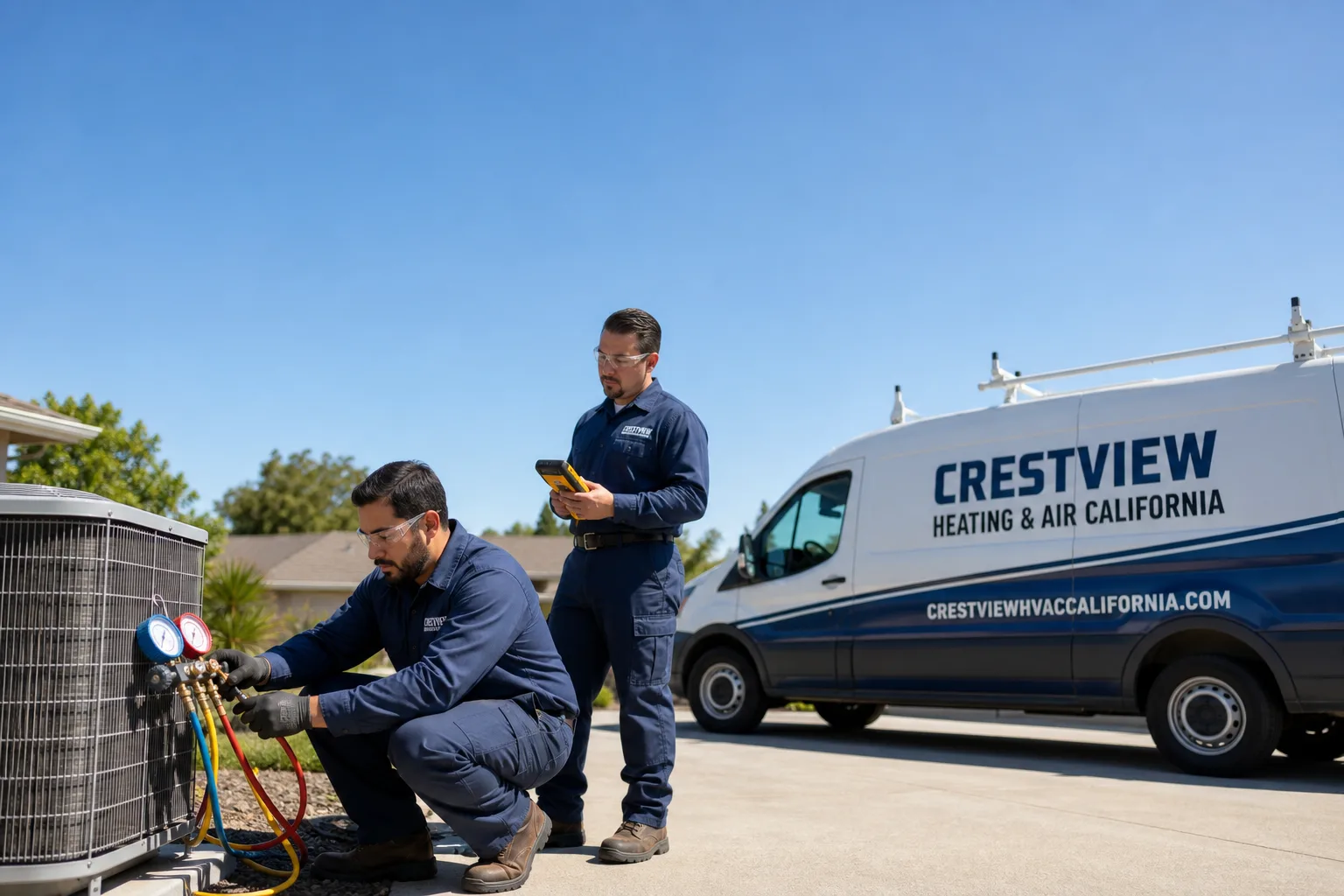
Fast, Reliable Emergency & Commercial HVAC Across Ontario
When your AC quits at 3 p.m. on a 108°F Ontario afternoon, or your warehouse rooftop unit trips on high-pressure during peak shipping season, you need someone who knows this specific heat. We’re Crestview Heating & Air California, and our Emergency & Commercial HVAC team serves Ontario’s mix of aging downtown homes and sprawling logistics facilities. From the 1950s tract houses near Holt Boulevard to the master-planned communities off Mountain Ave in 91761, we’ve handled the exact system failures this climate produces. Call (844) 560-6978 for emergency service or a free estimate.
Why Crestview Heating & Air California Is Ontario’s Preferred Emergency & Commercial HVAC Company
Ontario sits in a geographic heat trap east of the Puente Hills, shielded from any marine influence, which makes it one of the hottest spots in greater Los Angeles. We’ve spent nearly two decades learning what that means for HVAC systems here. Our 4.8-star average across 250+ customer reviews reflects real-world performance in conditions like these, not curated testimonials from milder climates.
Marcus Feldman, our owner, still serves as Service Manager. That means when you call Crestview, you’re not getting a dispatch center that outsources to anonymous subcontractors. You’re getting owner-managed accountability on every job, from a failed compressor in a central Ontario bungalow to a chiller issue at a distribution center near the I-10/I-15 interchange.
We know Ontario’s two worlds: the older residential stock near downtown built in the 1950s–70s, and the enormous commercial warehouse facilities that define the modern Inland Empire economy. That dual familiarity matters. A technician who only knows residential won’t grasp why your 20-ton rooftop unit keeps cycling on pressure faults. One who only knows commercial might miss why your 1960s ranch home’s undersized returns can’t handle a 110°F Santa Ana event.
Our factory training covers nine major brands: Carrier, Trane, Lennox, Goodman, Rheem, York, Daikin, Bryant, and American Standard. In Ontario, that range matters because builder-grade equipment from these manufacturers was installed across decades of tract development, and we’re not going to tell you “we don’t work on that.”
Our Emergency & Commercial HVAC Services in Ontario
24/7 Emergency HVAC
Ontario’s Santa Ana wind events blast through the Cajon Pass corridor with particular force in fall, routinely spiking temperatures to 90°F+ in October and November. Homeowners who “winterized” their systems in September get caught off guard. We take emergency calls when these surprise heat waves hit, because a system that sat idle for six weeks often fails when suddenly demanded to perform. Our emergency service covers all Ontario ZIP codes: 91764, 91798, 91758, and 91761.

Commercial HVAC
Ontario occupies the dead center of the Inland Empire’s logistics warehouse corridor. The commercial facilities along the I-10/I-15 interchange demand industrial-scale HVAC expertise that residential-only contractors simply don’t possess. We’ve serviced rooftop units, chillers, and split systems for warehouses, light manufacturing, and retail spaces throughout the Ontario business district. When your facility’s cooling fails during peak shipping season, every hour of downtime costs money. We understand that urgency because Marcus manages these jobs directly.

Rooftop Unit Service
Ontario’s commercial rooftops take brutal punishment. Ambient temperatures of 105–110°F mean rooftop units are drawing intake air that’s already scorching, pushing head pressures to their limits. We see high-pressure trips constantly in July and August, especially on units that haven’t had their condenser coils cleaned or refrigerant charge verified. Our team handles everything from belt and bearing replacements to full compressor swaps on commercial RTUs serving Ontario’s warehouse district.

Chiller Service
For larger commercial facilities in Ontario, chillers provide the backbone of climate control. These systems require specialized knowledge that general HVAC techs often lack. We’ve serviced centrifugal and scroll chillers for commercial clients whose operations can’t tolerate temperature swings. In Ontario’s extended cooling season, chillers accumulate more annual run-hours than equipment in coastal markets, making proactive maintenance essential rather than optional.

What happens when you call
- 1
A real person answersNo phone trees — you reach a local pro.
- 2
You get an upfront price rangeHonest numbers before anyone is dispatched.
- 3
A background-checked tech heads outLicensed & insured, dispatched right away.
- 4
You approve before work beginsNothing starts until you say go.
Trusted Brands We Service in Ontario
We maintain factory-trained compatibility across nine major brands, and we regularly stock parts for Trane, Lennox, Goodman, and Rheem systems that dominate Ontario’s housing stock. Trane and Lennox appear frequently in the 1990s–2000s master-planned homes of eastern Ontario, while Goodman and Rheem were the builder-grade standards in post-2010 tract development. That local parts availability means faster turnaround for Ontario customers. We’re not ordering from a warehouse three counties away and making you wait three days for a contactor or capacitor.
Common Emergency & Commercial HVAC Problems We See in Ontario Homes
- Builder-grade 13 SEER condensers short-cycling in afternoon peaks. The post-2010 tract homes in eastern Ontario were equipped with minimum-code condensers that can’t handle sustained 105°F+ operation. They trip on thermal overload right when you need them most, between 2 p.m. and 6 p.m.
- R-19 attic insulation degraded to effective R-10 by year five. Ontario’s attics bake at 150°F+ for months each summer. That heat load overwhelms insulation that was barely adequate when installed, forcing your AC to run 40% longer and still fail to reach setpoint.
- Refrigerant charge drift from microchannel coils. The low-cost Lennox and Goodman units installed in Ontario’s newer tracts came with factory charges that drift over high-run-hour summers. The result is suction pressure drop, evaporator freeze, and no cooling on the hottest days.
- Undersized returns choking airflow in home-office additions. Original 14-inch returns in 91761’s master-planned communities were designed for the base floor plan. When owners add square footage without upgrading ductwork, the system suffocates.
Pricing for Emergency & Commercial HVAC in Ontario, CA
We believe in upfront numbers, not vague “call for pricing” deflections. Here’s what typical Emergency & Commercial HVAC work runs in Ontario’s market:
| Service | Typical Range in Ontario |
|---|---|
| AC Repair | $150–$650 |
| Furnace Repair | $150–$700 |
| AC Installation | $3,500–$7,500 |
| Tune-Up | $80–$200 |
What moves you within these ranges? System age, accessibility, and whether we’re correcting builder-grade shortcuts. A simple capacitor replacement on an accessible condenser hits the low end. A compressor replacement on a rooftop unit in July, or a full duct redesign for a home-office addition, lands higher. We always provide written estimates before starting work, and our estimates are free. Call (844) 560-6978 to schedule yours.
Ontario’s Unique HVAC Challenge: Builder-Grade Tract Homes in 91761
Here’s what generic HVAC pages won’t tell you about Ontario. The eastern master-planned communities in ZIP 91761 were built with builder-grade air handlers and undersized returns, designed for the original tract’s cooling load but now struggling against 105°F+ summers. Original owners have added room additions and home offices without upgrading ductwork, and the systems are failing in predictable, fixable ways.
In a 2019-built home off Mountain Ave in the 91761 master-planned area, we found the 3-ton builder-grade Goodman air handler couldn’t keep the new home-office addition below 80°F. The ductwork had undersized 14-inch returns—typical for Ontario’s newer tracts—and the attic insulation was only R-19. We upsized the return to 18 inches, added R-38 blown-in insulation, and reset the txv for the higher heat load. The homeowner got a 12°F delta at the supply registers on the next 108°F day.
That’s the kind of targeted upgrade path we bring to Ontario homes. Not a generic “replace everything” sales pitch. Specific corrections for specific local failure modes.
We Also Serve Cities Near Ontario
Our service radius extends throughout the western Inland Empire. We regularly handle Emergency & Commercial HVAC calls in Montclair, Upland, Chino, and Claremont, often from customers who found us through Ontario referrals. If you’re near the Ontario border in any of these cities, the same response standards apply.
Serving Ontario, CA — Our Local Coverage Area
We’re based in the Ontario area and know this community well. Use the map below to see our service coverage — if you’re nearby, we can almost certainly help.
FAQs — Emergency & Commercial HVAC in Ontario
Your system was likely built to minimum code for a smaller cooling load than you’re actually experiencing. In Ontario’s 91761 master-planned communities, builder-grade 13 SEER condensers and R-19 attic insulation degrade quickly under sustained 105°F+ exposure, and undersized returns choke airflow when you need it most. We typically correct this with return upsizing, attic insulation to R-38, and refrigerant charge verification rather than full replacement. Call (844) 560-6978 for a free assessment.
Yes, it’s extremely common in Ontario’s logistics corridor. Rooftop units draw intake air at 105–110°F ambient, pushing discharge pressures to their design limits. Dirty condenser coils, overcharged refrigerant, or failing condenser fans are the usual culprits. We see this pattern constantly in July and August across Ontario’s warehouse district. Annual maintenance prevents most of these trips, but we also handle emergency repairs when they happen mid-season.
A proper tune-up will absolutely extend operational life and improve efficiency, though it can’t overcome fundamentally undersized ductwork. Our tune-ups include refrigerant charge verification, coil cleaning, electrical connection tightening, and airflow measurement. For Ontario’s high-run-hour environment, we recommend annual service rather than the biennial schedule that might suffice in milder climates. The $80–$200 tune-up range typically pays for itself in prevented emergency calls.
In most cases, yes. Central Ontario’s post-WWII and 1960s–70s homes have ductwork routed through unconditioned attics, which means we can often access and modify runs from above rather than opening walls. We frequently add return air pathways, seal leaks with mastic, and upsize trunk lines through attic access points. Every home is different, but wall demolition is rarely necessary for meaningful duct improvement in this vintage of Ontario housing.
Absolutely. Ontario’s position near the Cajon Pass makes it uniquely vulnerable to fall Santa Ana events that spike temperatures to 90°F+ when coastal cities have cooled. Systems that sat idle for six weeks often fail on first demand. We recommend keeping your AC operational through November, and scheduling a fall inspection if you’ve already “winterized.” Our emergency line stays active for exactly these surprise heat events. Call (844) 560-6978 if your system won’t fire up when the winds hit.
Written by Marcus Feldman, Owner and Service Manager at Crestview Heating & Air California, serving Ontario and the Inland Empire since 2005.