
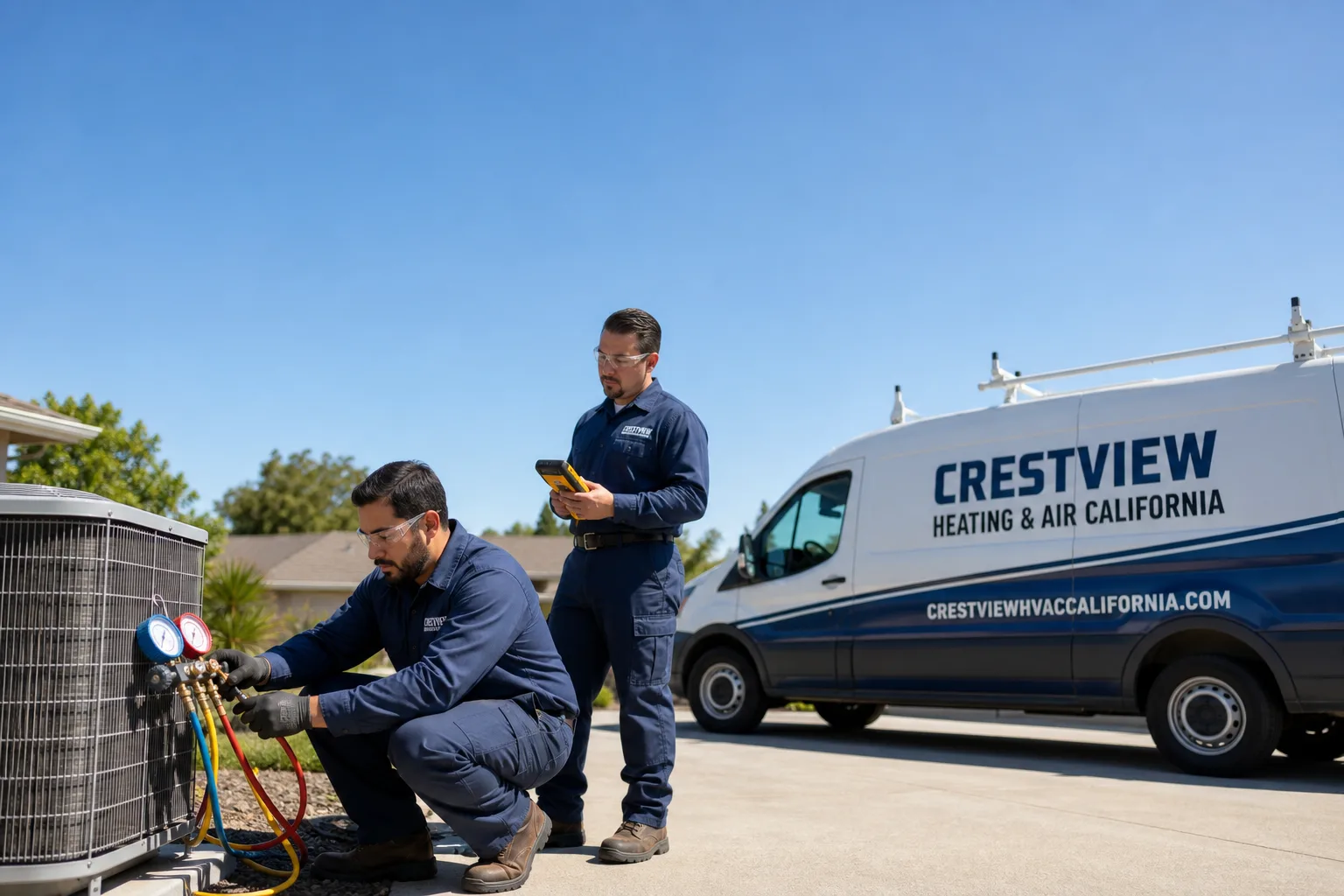
Fast, Reliable Emergency & Commercial HVAC Across San Carlos
When your rooftop unit fails on a Friday evening or your furnace quits during a damp San Carlos winter night, you need an HVAC team that knows this city’s hills and flats as well as you do. We answer emergency calls throughout 94070, from the sun-baked commercial strips near El Camino Real to the fog-cooled hillside homes climbing toward Edgewood Park. Call (844) 560-6978 — our Emergency & Commercial HVAC team is ready.
Marcus Feldman, our owner and Service Manager, has spent 19 years in the HVAC industry, and that experience includes plenty of early mornings on Brittan Avenue and late nights near Redwood Shores Parkway. We don’t dispatch from a call center three counties away. We know that a rooftop unit on a flat-roof commercial building near Highway 101 faces different corrosion stress than a heat pump tucked into a hillside garage off Crestview Drive, and we size our responses accordingly.
Why Crestview Heating & Air California Is San Carlos’s Preferred Emergency & Commercial HVAC Company
Our 4.8-star average rating across 250+ customer reviews didn’t come from generic service. It came from showing up in San Carlos with the right parts, the right diagnosis, and an owner who still manages jobs in the field. Marcus Feldman holds the title of Service Manager, which means ownership-level accountability is built into daily operations — not just the sales pitch.
San Carlos’s steep east-west topography creates two distinct microclimates within the same ZIP code. The flat, sun-exposed neighborhoods near El Camino Real and the Caltrain corridor regularly run 10–15°F warmer than the fog-shrouded hillside streets climbing toward Edgewood Park to the west. HVAC contractors here must run genuinely different load calculations for homes of identical square footage depending solely on which side of the hill they sit on — a split far more dramatic than in neighboring Belmont or Redwood City. That microclimate-aware system sizing is the defining skill for San Carlos HVAC work, and it’s why our 19 years of experience matters.
We respond to emergency calls throughout San Carlos without the impersonal layers of a franchise outfit. From commercial buildings near Holly Street to residential systems off Alameda de las Pulgas, our familiarity with local conditions means faster diagnosis and repairs that actually hold up.
Our Emergency & Commercial HVAC Services in San Carlos
24/7 Emergency HVAC
Coastal salt air in San Carlos accelerates corrosion on HVAC hardware — condenser coils, fasteners, electrical connections, and cabinet seams — causing failure 2–3 years faster than inland areas. We responded to an emergency call on a commercial garage off Brittan Avenue where a rusted opener chain snapped mid-cycle, trapping a delivery truck. We replaced the chain with a stainless steel model, swapped corroded springs for galvanized ones, and added nylon rollers to prevent further salt-air damage. That same corrosion pattern attacks rooftop unit condenser coils on commercial buildings throughout the 94070 flatlands, leading to refrigerant leaks and efficiency collapse. Our emergency team carries galvanized and coated replacement components specifically for coastal environments, and we stock parts compatible with Trane, Lennox, Goodman, and Rheem systems common in Peninsula commercial properties.

Commercial HVAC
San Carlos’s commercial core — the retail and light industrial buildings along El Camino Real, Old County Road, and the Brittan Avenue corridor — relies heavily on rooftop package units and split systems that take direct salt-air exposure. We service these systems with factory-trained compatibility across nine major brands, including Carrier, Trane, Lennox, Goodman, Rheem, York, Daikin, Bryant, and American Standard. Your system, our specialty. From emergency calls to commercial buildouts, we handle refrigerant leak detection, coil replacement, economizer repairs, and full system changeouts. We understand that a failed rooftop unit on a Monday morning means lost revenue, not just lost comfort.

Rooftop Unit Service
Rooftop units in San Carlos face a brutal combination: salt spray from marine air, thermal cycling between fog-cooled mornings and direct afternoon sun on flat commercial roofs, and vibration stress from Caltrain corridor traffic. The hillside homes west of Brittan Avenue present different challenges — summer fog keeps attic temps low enough that cooling hours rarely justify central AC install, while an identical-sized house four blocks east on the sunny flats near El Camino would legitimately benefit from it. For commercial rooftops, we inspect condensate drainage (critical where damp winters stretch long), check coil fin integrity, and verify that economizer dampers aren’t seized from salt corrosion. Annual maintenance catches these failures before they become emergency shutdowns.

Chiller Service
While smaller commercial properties in San Carlos more commonly use rooftop package units, the medical offices, data-adjacent light industrial spaces, and larger retail facilities near Redwood Shores Parkway and along Highway 101 occasionally rely on chilled-water systems. Chiller maintenance here demands attention to condenser water chemistry — salt air accelerates tower basin corrosion and legionella risk — and careful monitoring of refrigerant levels where micro-leaks develop faster than inland equivalents. Our 19 years of experience includes chiller startups, tube cleaning, and compressor rebuilds for the Peninsula’s light commercial market.

Annual Maintenance & HVAC Inspection
Annual maintenance is where San Carlos’s coastal conditions make the biggest difference in total cost of ownership. We inspect condensate drainage management more carefully here than in warmer South Bay markets like San Jose or Milpitas, because damp, cool winters stretch long enough that heat pump defrost performance and drainage pathways matter considerably more. Moisture intrusion in ductwork from coastal fog causes mold growth and airflow blockages, especially in hillside homes with poor condensate drainage. Our maintenance visits include corrosion inspection of outdoor cabinets, coil cleaning with salt-removal chemistry, and electrical connection torque verification — the failures that salt air causes first.

What happens when you call
- 1
A real person answersNo phone trees — you reach a local pro.
- 2
You get an upfront price rangeHonest numbers before anyone is dispatched.
- 3
A background-checked tech heads outLicensed & insured, dispatched right away.
- 4
You approve before work beginsNothing starts until you say go.
Trusted Brands We Service in San Carlos
We service equipment from nine major HVAC brands: Carrier, Trane, Lennox, Goodman, Rheem, York, Daikin, Bryant, and American Standard. For San Carlos customers, this means we don’t tell you “we don’t work on that” when your Goodman rooftop unit fails or your Rheem heat pump starts short-cycling. We stock common parts locally for faster turnaround on emergency calls, and our factory training covers warranty procedures so you’re not caught between us and the manufacturer when a coil fails under coverage. 250+ customers who left reviews agree — brand flexibility matters when you’re facing a weekend emergency.
Common Emergency & Commercial HVAC Problems We See in San Carlos Homes
- Salt-corroded rooftop unit condenser coils and fasteners on commercial buildings near El Camino Real and Highway 101, leading to refrigerant leaks and reduced efficiency within 2–3 years of installation. The marine layer deposits chloride-rich moisture that standard aluminum fins and galvanized fasteners weren’t designed to resist indefinitely.
- Corroded garage door springs snapping without warning on hillside homes near Edgewood Park, requiring immediate replacement to secure the opening. The same salt air that attacks HVAC cabinets accelerates spring fatigue on attached garage doors, often catching homeowners off-guard during morning departures.
- Moisture intrusion and mold growth in ductwork from coastal fog penetration, especially in hillside homes with poor condensate drainage. San Carlos’s prolonged damp season means condensate lines that would stay clear in drier climates become biofilm breeding grounds.
- Heat pump defrost cycle failures in the fog-cooled western neighborhoods, where extended run times in near-freezing, high-humidity conditions overwhelm standard defrost controls. These systems need more frequent defrost board inspection and sensor calibration than inland equivalents.
Pricing for Emergency & Commercial HVAC in San Carlos, CA
Honest pricing means actual numbers, not “call for a quote” dodges. Here’s what typical Emergency & Commercial HVAC work runs in the San Carlos market:
| Service | Typical Range in San Carlos |
|---|---|
| AC Repair | $150–$650 |
| Furnace Repair | $150–$700 |
| AC Installation | $3,500–$7,500 |
| Tune-Up / Annual Maintenance | $80–$200 |
Emergency service calls outside standard hours may carry additional trip charges, but we quote upfront before any work begins. Several factors push San Carlos jobs toward the higher end of these ranges: coastal corrosion damage requiring component replacement rather than simple repair, access difficulty on hillside properties with steep driveways or limited parking, and the need for stainless or coated hardware upgrades to resist salt air. The flatlands near El Camino Real generally see more straightforward access but heavier cooling load requirements. Every estimate we provide is free — call (844) 560-6978 to schedule.
We Also Serve Cities Near San Carlos
Our service radius covers the full mid-Peninsula corridor. We regularly respond to emergency and commercial HVAC calls in Belmont, Redwood Shores, Redwood City, and North Fair Oaks — each with their own microclimate quirks, but all sharing the same salt-air exposure that defines Peninsula coastal HVAC work. If you’re managing commercial properties across multiple cities, our owner-managed consistency means the same technical standards apply whether we’re on Brittan Avenue or Woodside Road.
Serving San Carlos, CA — Our Local Coverage Area
We’re based in the San Carlos area and know this community well. Use the map below to see our service coverage — if you’re nearby, we can almost certainly help.
FAQs — Emergency & Commercial HVAC in San Carlos
Salt air corrosion of condenser coils and line-set fittings is the most common cause of recurring refrigerant leaks on Brittan Avenue commercial properties. The marine layer deposits chloride-rich moisture that pits aluminum fins and attacks brazed joints, creating micro-leaks that worsen with each thermal cycle. We typically find 2–3 years of salt exposure is enough to compromise factory coatings on standard rooftop units. Call (844) 560-6978 — we’ll pressure-test the system, identify all leak points, and quote coated or stainless replacement components that resist this environment better.
Garage door springs on hillside homes near Edgewood Park typically need replacement every 5–7 years, compared to 8–12 years inland, due to accelerated salt-air corrosion. The marine layer lingers longer on the western slopes, and morning fog deposits corrosive film on springs, hinges, and cables even when skies clear by afternoon. We install galvanized or coated springs specifically for coastal environments, and we recommend annual lubrication with corrosion-inhibiting compound. If your spring shows rust flecking or the door feels heavier to lift, it’s time for inspection.
Yes, we respond to emergency HVAC calls for commercial buildings throughout the El Camino Real corridor in San Carlos, including retail, restaurant, and office properties. Our emergency team carries parts for the nine major brands we service, and Marcus Feldman, our owner and Service Manager, often personally oversees commercial emergency responses to ensure proper diagnosis and temporary cooling or heating solutions while permanent repairs are arranged. Call (844) 560-6978 — we’re familiar with the access constraints and parking limitations common to this busy commercial strip.
For a 1950s ranch on the sunny San Carlos flats, a ducted mini-split is often the best solution because these homes were originally built with floor furnaces or gravity wall heaters and zero duct infrastructure. Full forced-air retrofits through finished spaces are possible but invasive; ducted mini-splits use compact refrigerant lines and small ceiling or wall cassettes that avoid major drywall demolition. The sunny flats near El Camino run 10–15°F warmer than the hillsides, so cooling capacity matters — and mini-splits offer efficient variable-speed cooling without the duct losses of a full retrofit. We size these systems based on actual load calculations for your specific microclimate, not square-footage rules of thumb.
Usually no — and we’ll tell you that upfront. Techs working the hillside streets west of Brittan Avenue routinely talk homeowners out of adding central AC not on cost grounds but on load grounds. Summer fog keeps attic temps low enough that cooling hours rarely justify the install, while an identical-sized house four blocks east on the sunny flats near El Camino would legitimately benefit. For hillside homes, we more often recommend a single-zone mini-split for occasional hot days, or improved attic ventilation and insulation to reduce the few uncomfortable hours. If a contractor quotes central AC for your Edgewood Park-area home without running a microclimate-specific load calculation, get a second opinion. Call (844) 560-6978 for a free, honest assessment.
Ready to solve your San Carlos HVAC problem? Whether it’s a salt-corroded rooftop unit on your commercial building, an emergency furnace failure on a foggy hillside night, or annual maintenance to prevent the corrosion that defines Peninsula coastal HVAC life, Crestview Heating & Air California delivers owner-managed service backed by nearly two decades of hands-on experience. Call (844) 560-6978 for a free estimate — we’re familiar with your neighborhood, your microclimate, and the specific brands in your system.
Written by Marcus Feldman, Owner and Service Manager at Crestview Heating & Air California, serving San Carlos and the mid-Peninsula since 2005.