
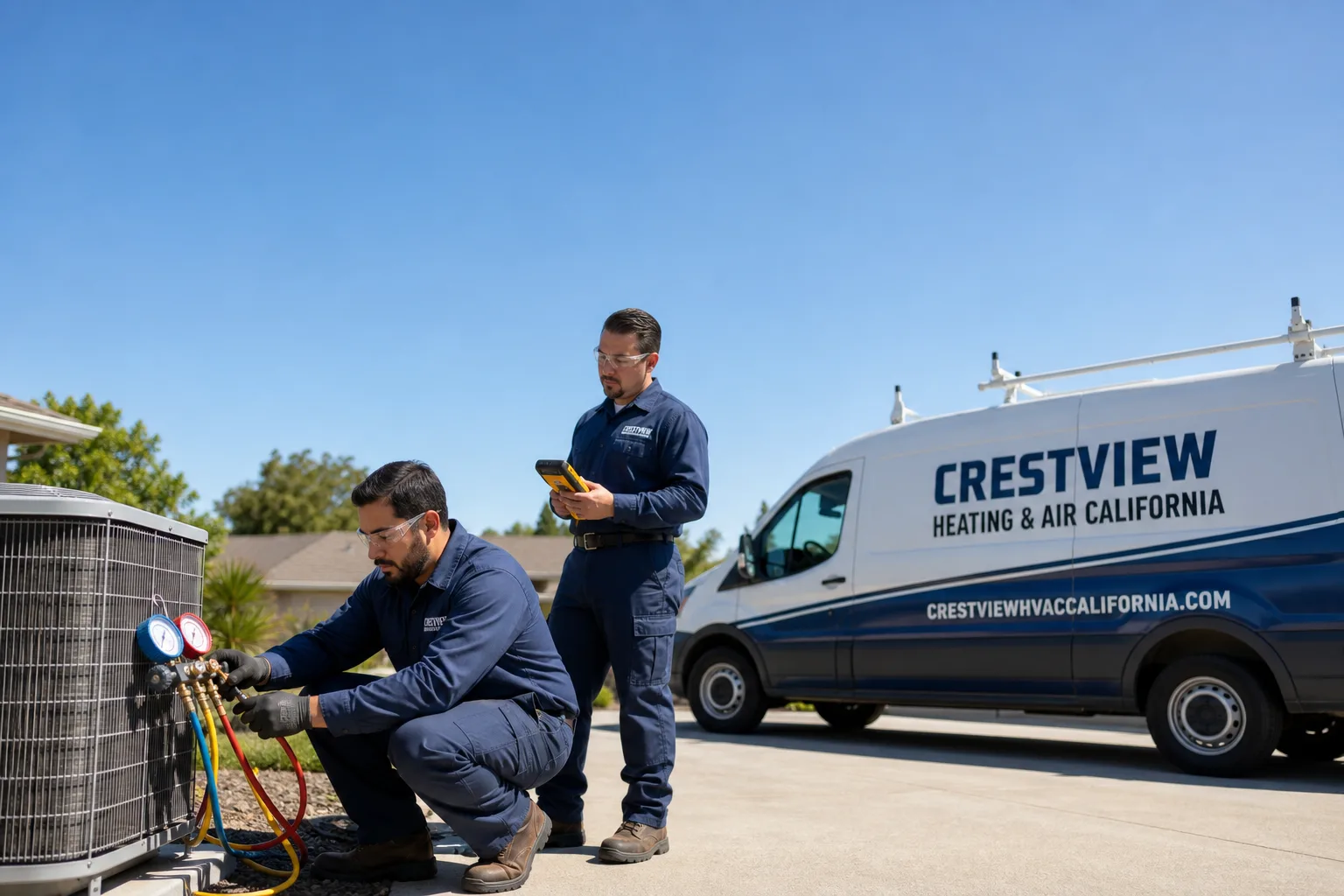
Fast, Reliable Heat Pump & Mini Split Across San Francisco
Heat pump and mini split installation in San Francisco typically runs $4,130–$8,850, with most repairs falling between $175–$765. We’re Crestview Heating & Air California, and our Heat Pump & Mini Split team makes the trip up from San Jose to serve San Francisco homeowners and commercial properties with the same owner-managed service we’ve built our reputation on. Call (844) 560-6978 for a free estimate.
Nearly two decades of HVAC experience means we’ve worked on virtually every system configuration San Francisco’s unusual housing stock can throw at us. From Victorian flats in the Mission District with horsehair-plaster walls and zero ductwork, to converted SoMa lofts with seismic-bracing requirements, to fog-belt Sunset homes where salt air eats condenser coils alive. San Francisco’s micro-climates and coastal conditions create HVAC challenges you simply don’t see in inland markets. We’ve learned those lessons across 19 years and 250+ customer reviews averaging 4.8 stars.
Why Crestview Heating & Air California Is San Francisco’s Preferred Heat Pump & Mini Split Company
Our owner, Marcus Feldman, still serves as Service Manager on jobs. That’s not a title on a business card; it’s how we operate. When you call Crestview, you’re talking to a company where ownership-level accountability is built into daily operations, not buried under layers of dispatchers and subcontractor networks.
Those 250+ reviews didn’t come from a handful of cherry-picked testimonials. They came from real jobs across the Bay Area, including San Francisco, where customers specifically mention our responsiveness and willingness to tackle unusual installations. We’re factory-trained across nine major brands, so when your San Francisco flat has a Lennox, Trane, Goodman, or Rheem system, we don’t tell you “we don’t work on that.” Your system, our specialty.
Our response time to San Francisco is built around the reality of Peninsula traffic patterns. We schedule strategically to avoid the worst of 101 and 280 congestion, which means we’re typically on-site in San Francisco within a predictable window, not “sometime between 8 and 5.” For emergency calls, that planning matters even more.
What separates us in San Francisco specifically is our familiarity with the local building stock. We’ve routed mini-split lines through Edwardian row houses with balloon-frame construction, worked around the seismic-bracing requirements that California’s CBC and ASCE 7 codes impose on SoMa loft conversions, and specified corrosion-resistant coatings for coastal installations that most inland HVAC contractors simply don’t think about.
Our Heat Pump & Mini Split Services in San Francisco
Mini Split Install
Mini split installation is our most requested service in San Francisco, and for good reason. The city’s Victorian and Edwardian housing stock, built overwhelmingly between 1890 and 1920, was never designed for ducted central air. Balloon-frame construction, horsehair-plaster walls, and minimal attic or sub-floor clearance make traditional ductwork installation prohibitively invasive and expensive. A ductless mini-split system lets us mount compact wall or ceiling heads in individual rooms, run refrigerant lines through narrow wall chases, and place a small outdoor condenser unit where space allows.
We recently installed a Daikin multi-zone ductless system in a 1907 Edwardian flat in the Mission District (94110). The homeowner’s original wall furnace had failed, and we routed refrigerant lines through horsehair-plaster walls with zero attic clearance, installing three wall-mounted heads to handle the 95°F heat dome conditions while keeping the unit’s condenser protected from salt air with a corrosion-resistant coating. That job is typical of what we see in San Francisco: not a simple equipment swap, but a ground-up system design conversation.

Ductless System
Ductless systems aren’t just mini-splits by another name in San Francisco; they’re often the only practical path to both heating and cooling in buildings that have survived a century without either. Many flats in the Tenderloin, Nob Hill, and Mission still rely on original Williams or Empire single-room gravity wall furnaces, floor-mounted gas heaters with no duct connections and increasingly scarce replacement parts. When those fail, replacement parts can be impossible to source. A ductless system eliminates that dependency entirely.
The other advantage in San Francisco’s climate is precision. The marine layer keeps average July highs near 63–65°F, but heat domes can push the Mission and SoMa past 95°F while Nob Hill sits 15–20°F cooler under fog the same afternoon. A ductless system lets you condition only the spaces you’re using, rather than fighting to cool an entire building when half of it doesn’t need it.

Multi-Zone System
Multi-zone systems are where San Francisco’s micro-climate reality really demands specialized design. A single mini-split head in a Mission flat might handle the living room beautifully during a September heat event, but leave the south-facing bedroom sweltering and the north-facing kitchen cold. We’ve seen this exact pattern repeatedly. Multiple heads, each with independent temperature control, solve it.
Our multi-zone installations in San Francisco typically use 2–4 indoor heads connected to a single outdoor condenser. This reduces the outdoor footprint, which matters in buildings with limited exterior wall access or strict HOA requirements. It also means one outdoor unit to protect from salt-air corrosion instead of several.

Heat Pump Repair
Heat pump repair in San Francisco presents unique failure modes that inland technicians rarely encounter. Salt-air corrosion on mini-split condenser coils and fan blades leads to refrigerant leaks and compressor failures within 3–5 years in coastal ZIPs like 94122. Fog-driven moisture causes outdoor unit electrical connections to corrode, tripping breakers or causing intermittent operation, especially in fog-belt neighborhoods like the Sunset. We’ve replaced enough corroded contactors and cleaned enough salt-caked coils to know the warning signs before total failure.

Heat Pump Installation
Full heat pump installation in San Francisco often means replacing those original wall furnaces with a modern, efficient system that both heats and cools. The sizing calculations are unusually location-sensitive here. A heat pump sized for average San Francisco conditions will fail during heat dome events; one sized for extremes will short-cycle and waste energy during normal foggy summers. We run load calculations that account for your specific block’s micro-climate, not just city-wide averages.

Mini Split Repair
Mini split repair calls in San Francisco spike in late summer, when heat dome stress reveals weaknesses: refrigerant leaks from vibration-weakened flare connections, failed inverter boards from voltage fluctuation, and the ever-present corrosion issues. Our $175–$765 repair range covers most common fixes, with refrigerant leaks and electrical repairs trending toward the higher end due to diagnostic time.

What happens when you call
- 1
A real person answersNo phone trees — you reach a local pro.
- 2
You get an upfront price rangeHonest numbers before anyone is dispatched.
- 3
A background-checked tech heads outLicensed & insured, dispatched right away.
- 4
You approve before work beginsNothing starts until you say go.
Trusted Brands We Service in San Francisco
We maintain factory-trained compatibility across nine major HVAC brands: Carrier, Trane, Lennox, Goodman, Rheem, York, Daikin, Bryant, and American Standard. For San Francisco’s coastal conditions, we particularly specify Trane and Rheem outdoor units with enhanced corrosion protection, and we’ve had strong results with Daikin’s coastal-rated condenser coatings for ductless installations. We stock common parts locally and coordinate with Bay Area distributors for faster turnaround on specialty components. That means less waiting for San Francisco customers, especially when a failed heat pump during a heat dome can’t wait.
Common Heat Pump & Mini Split Problems We See in San Francisco Homes
- Salt-air corrosion on condenser coils and fasteners. The marine layer’s salt-laden fog accelerates corrosion on outdoor mini-split condenser coils and fasteners, causing system failures 2–3 years sooner than in inland cities like Walnut Creek. We specify corrosion-resistant coatings and inspect coastal installations annually.
- Fog-driven electrical corrosion. Outdoor unit electrical connections corrode in fog-belt neighborhoods, causing intermittent operation or complete shutdowns. We see this most in the Sunset and Richmond districts, where the marine layer lingers longest.
- Undersized mini-split heads for microclimate zones. A single head can’t handle the temperature swings between rooms in San Francisco’s varied topography. We design multi-zone systems that account for solar gain, exposure, and the city’s notorious block-by-block weather variations.
- Refrigerant leaks from vibration in old building structures. Balloon-frame Victorians transmit more vibration than modern platform framing. We’ve learned to specify vibration-isolation mounts and check flare connections more frequently in San Francisco’s pre-1920 housing stock.
Pricing for Heat Pump & Mini Split in San Francisco, CA
Honest pricing matters, especially in a market where many San Francisco homeowners are navigating their first HVAC installation in a building that never had central air. Here’s what we typically see:
| Service | Price Range in San Francisco |
|---|---|
| Mini Split Installation | $4,130–$8,850 |
| Mini Split Repair | $175–$765 |
| Tune-Up | $95–$235 |
What moves you within these ranges? Number of indoor heads, electrical panel capacity in older buildings, line-set routing complexity through plaster walls, seismic bracing requirements for SoMa and newer construction, and whether we need corrosion-resistant coatings for coastal exposure. Victorian and Edwardian retrofits trend higher due to access challenges; simpler single-head installations in buildings with modernized electrical can land at the lower end. We provide free, itemized estimates before any work begins. Call (844) 560-6978 to schedule yours.
We Also Serve Cities Near San Francisco
Our service radius extends throughout the Peninsula and into San Francisco proper, including the Mission District, Noe Valley, Chinatown, and Visitacion Valley. Each neighborhood presents its own micro-climate and building-stock variations, and we’ve worked in all of them. Whether you’re in a Chinatown walk-up with limited roof access or a Noe Valley Victorian with original plaster walls, we adapt our approach to what’s actually there.
Serving San Francisco, CA — Our Local Coverage Area
We’re based in the San Francisco area and know this community well. Use the map below to see our service coverage — if you’re nearby, we can almost certainly help.
FAQs — Heat Pump & Mini Split in San Francisco
Yes, the marine layer’s salt-laden fog accelerates corrosion on outdoor mini-split condenser coils and fasteners, causing failures 2–3 years sooner than in inland cities. We combat this with corrosion-resistant coatings, more frequent electrical connection inspections, and stainless-steel hardware upgrades where specified. If you’re in a fog-belt neighborhood like the Sunset or Richmond, mention it when you call (844) 560-6978 for a free estimate, and we’ll factor coastal protection into your system design.
Yes, and it’s one of our most common installations in San Francisco. Ductless mini-splits require no ductwork; we route refrigerant lines through wall chases, floor joist bays, or exterior line-hide covers. We’ve completed dozens of these in 1890–1920 Edwardian and Victorian flats across the Mission, Tenderloin, and Nob Hill where original gravity wall furnaces provided the only heat. The key challenge is access, not feasibility. Call us to assess your specific layout.
San Francisco’s micro-climates create uneven heating and cooling even within the same flat. A single head in your Mission District living room might handle 95°F heat dome conditions beautifully while your south-facing bedroom stays stifling and your north-facing kitchen stays cold. Multi-zone systems with 2–4 independently controlled heads solve this without the energy waste of oversizing. We’ve installed these specifically for Mission customers who learned the hard way that one head isn’t enough.
We specify Trane and Rheem outdoor units with enhanced corrosion protection for most coastal San Francisco installations, and we’ve had excellent results with Daikin’s coastal-rated condenser coatings for ductless systems. The right choice depends on your specific exposure, building type, and whether you’re in a fog-belt neighborhood versus a sunnier micro-climate zone. We don’t push one brand; we match the equipment to your conditions. Call (844) 560-6978 and we’ll walk through what makes sense for your location.
California’s CBC and ASCE 7 seismic-bracing requirements add significant engineering and installation cost for HVAC equipment in SoMa’s converted warehouse lofts and concrete mid-rises. Wall-mounted mini-split heads require approved anchorage to concrete or steel, and outdoor condensers on rooftops or mechanical platforms need seismic restraints that residential installations don’t. We’ve completed these installations and can provide code-compliant designs that satisfy building inspectors and HOA requirements. The additional cost is typically $800–$2,400 depending on unit size and mounting complexity. Call for a specific quote.
Ready to solve your San Francisco heating and cooling challenge? Whether you’re replacing a failed wall furnace in a century-old flat, adding cooling to a SoMa loft, or protecting coastal equipment from salt-air corrosion, Crestview Heating & Air California brings nearly two decades of hands-on experience and owner-managed accountability to every job. Call (844) 560-6978 for your free estimate. From emergency calls to commercial buildouts, we’re here to help.
Written by Marcus Feldman, Owner and Service Manager at Crestview Heating & Air California, serving San Francisco and the Bay Area since 2005.