
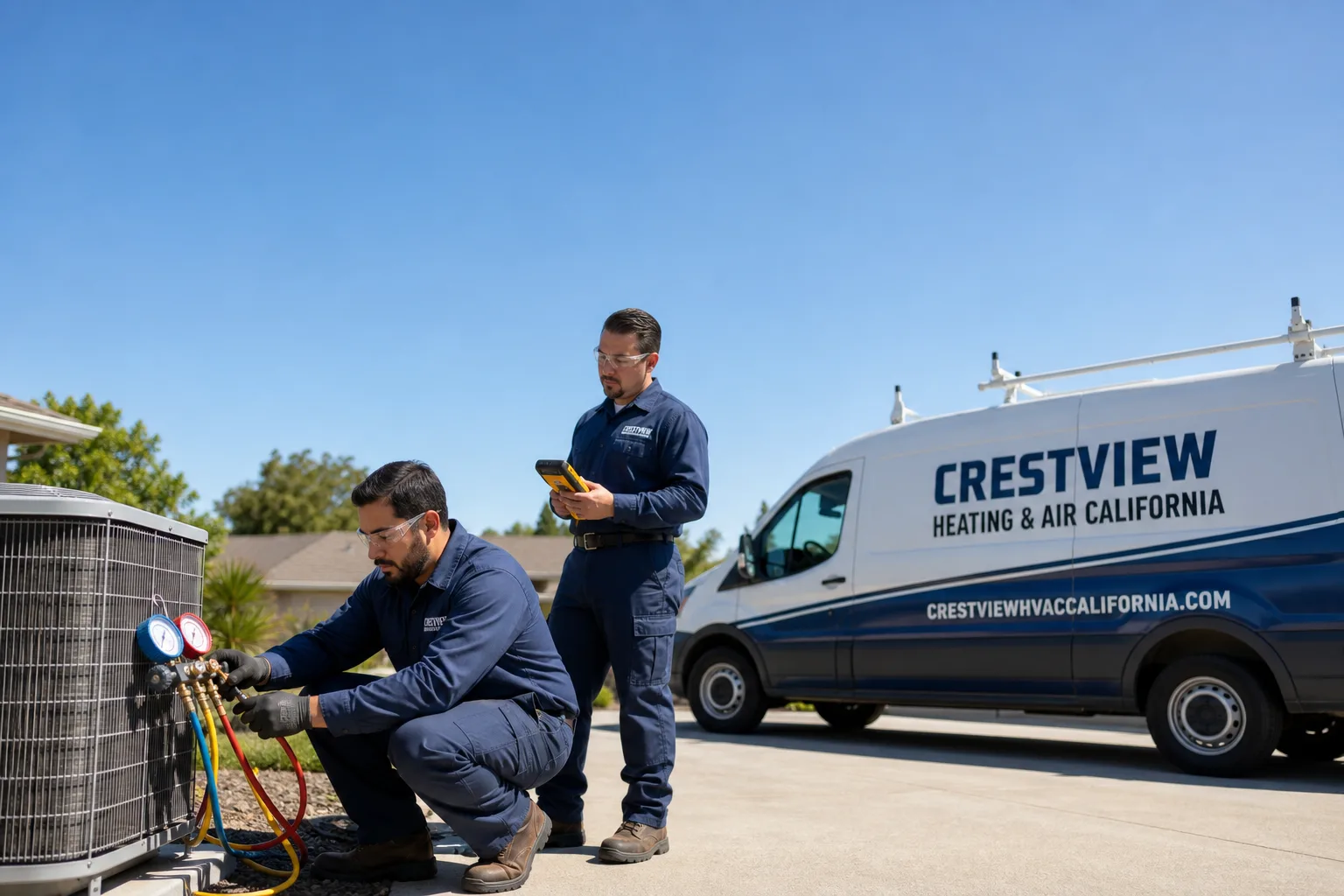
Fast, Reliable Heat Pump & Mini Split Across Stanford
Heat pump and mini split installation in Stanford, CA typically runs $3,800–$8,200 for residential systems, with most projects completed in one to two days. We’re Crestview Heating & Air California, and our Heat Pump & Mini Split team serves Stanford from our San Jose base. Whether you live in a 1960s faculty ground-lease home near Santa Rita Avenue or manage a research facility off Campus Drive, we understand the unique approval layers and microclimate factors that shape every job here. Call (844) 560-6978 for a free estimate.
Stanford sits at the base of the Santa Cruz Mountains in a recognized fog corridor, producing summers that routinely stay in the upper 60s to low 70s°F, measurably cooler and more humid than inland Palo Alto just a mile or two east. This microclimate means central cooling is rarely cost-justified in residential work, but efficient forced-air heating, ventilation, and condensation management are the core selling points for any HVAC upgrade. We’ve spent nearly two decades working in these conditions, and we know how to size systems that won’t short-cycle or waste energy in Stanford’s mild, damp air.
Why Crestview Heating & Air California Is Stanford’s Preferred Heat Pump & Mini Split Company
Our 4.8-star average across 250+ customer reviews reflects consistent real-world performance, not a handful of curated testimonials. Stanford homeowners and campus facilities managers have told us they value one thing above all: accountability. Owner Marcus Feldman serves as our Service Manager, meaning ownership-level accountability is built into daily operations, not just the sales pitch. When you call Crestview, you’re not reaching a dispatch center that routes you to an anonymous subcontractor. You’re talking to a team where the owner still manages jobs in the field.
We’re factory-trained across nine major brands, including Trane, Lennox, and Rheem, so we’re never in a position to tell you “we don’t work on that.” From emergency calls to commercial buildouts, our range matches what Stanford actually needs. We’ve responded to after-hours failures in faculty housing near Frenchman’s Road and coordinated multi-zone installations for research groups on the main campus. Our familiarity with Stanford’s ground-lease approval process, university EH&S protocols, and Santa Clara County permitting saves our customers weeks of delay on complex projects.
Our Heat Pump & Mini Split Services in Stanford
Mini Split Install
Mini split installation is our most requested service in Stanford, and for good reason. The residential stock here consists largely of faculty and staff homes built in the 1950s–1970s on university-owned land under ground leases, meaning structural and mechanical upgrades often require Stanford Real Estate approval in addition to Santa Clara County permits. Many of these homes retain original duct layouts designed for mild Bay Area conditions, making proper airflow balancing a recurring issue when systems are replaced. A ductless mini split bypasses this entirely.
Last fall, we retrofitted a Daikin multi-zone mini-split in a 1960s faculty home on Santa Rita Avenue. The original ductwork for the forced-air furnace was undersized and leaking, so we installed three ductless heads, a 12k BTU in the living room and two 9k units in bedrooms, providing zoned heating without the $6,500 cost of a full duct renovation. That’s the kind of solution we specialize in: practical, cost-effective, and tailored to Stanford’s unique housing constraints.

Ductless System
Ductless systems are ideal for Stanford’s older homes, additions, and converted spaces where extending existing ductwork is impractical or prohibitively expensive. Original 1950s–70s ground-lease homes have single-pane windows and poor insulation, causing mini-splits to short-cycle in Stanford’s mild climate if sized solely by square footage. We calculate load manually, factoring in the fog corridor’s humidity, the home’s envelope leakage, and actual occupancy patterns. A system that’s too large will cycle on and off constantly, wasting energy and failing to dehumidify properly. We don’t let that happen.

Multi-Zone System
Multi-zone mini splits let you control temperature room by room, which matters in Stanford’s varied housing stock. A faculty home on Gerona Road might have a south-facing office that overheats on rare clear afternoons while north bedrooms stay chilly. A multi-zone system with individual heads solves this without the energy penalty of heating or cooling unused spaces. Faculty housing’s original electrical panels often lack capacity for modern multi-zone mini-splits, requiring a panel upgrade that must be approved by Stanford Real Estate. We handle that coordination, so you don’t navigate university bureaucracy alone.

Heat Pump Repair
Heat pump repair in Stanford demands familiarity with systems that run in heating mode most of the year and rarely see heavy cooling loads. This usage pattern can mask refrigerant leaks or compressor issues until a cold snap hits. We diagnose quickly, stock common parts for Trane, Lennox, and Rheem systems, and get your heat back on before the fog rolls in. For campus buildings, we coordinate with Stanford facilities to schedule work around research operations.

Heat Pump Installation
When a heat pump reaches end of life, replacement in Stanford requires more than swapping equipment. Ground-lease homes need Stanford Real Estate sign-off for any exterior modifications, including pad-mounted condensers or line-set routing. We prepare documentation upfront, submit through proper channels, and schedule installation for the earliest approved date. Typical heat pump installation in Stanford runs $4,500–$8,200 depending on tonnage, electrical requirements, and whether duct modifications are needed.

Mini Split Repair
Mini split repair calls in Stanford often trace to installation errors from out-of-area contractors unfamiliar with local conditions. Improperly flared connections corrode in the marine-layer humidity. Undersized electrical circuits cause intermittent faults. We fix these issues correctly, then verify the system performs across Stanford’s full temperature and humidity range. For campus labs, 24/7 exhaust systems cannot be interrupted for refrigerant line repairs without rescheduling research groups, often forcing emergency after-hours work. We’re equipped for that.

What happens when you call
- 1
A real person answersNo phone trees — you reach a local pro.
- 2
You get an upfront price rangeHonest numbers before anyone is dispatched.
- 3
A background-checked tech heads outLicensed & insured, dispatched right away.
- 4
You approve before work beginsNothing starts until you say go.
Trusted Brands We Service in Stanford
We service equipment from nine major brands: Carrier, Trane, Lennox, Goodman, Rheem, York, Daikin, Bryant, and American Standard. For Stanford customers, this means we stock local parts for the brands most commonly found in faculty housing and campus buildings. Trane and Lennox dominate the 1990s–2000s replacement cycle in ground-lease homes; Rheem and Goodman appear frequently in newer installations. We don’t cherry-pick. Your system, our specialty. Fast turnaround because we’re not ordering parts from three counties away.
Common Heat Pump & Mini Split Problems We See in Stanford Homes
- Short-cycling from oversizing. Original 1950s–70s ground-lease homes have single-pane windows and poor insulation, causing mini-splits to short-cycle in Stanford’s mild climate if sized solely by square footage. We see this constantly in homes near Campus Drive where a previous contractor installed a 24k BTU single-head system for a 900-square-foot space. The unit blasts cold air for three minutes, shuts off, and repeats. Proper load calculation prevents this.
- Electrical panel limitations. Faculty housing’s original electrical panels lack capacity for modern multi-zone mini-splits, requiring a panel upgrade that must be approved by Stanford Real Estate. We’ve encountered 100-amp panels in 1960s homes that can’t handle a three-zone Daikin plus existing electric range and dryer. We identify this during our initial assessment, not on installation day.
- Condensation and moisture management. Stanford’s fog corridor produces persistent humidity that overwhelms poorly drained condensate lines. We route drains properly, install condensate pumps where gravity drainage isn’t possible, and verify float switches to prevent water damage in homes with original hardwood floors.
- Campus lab scheduling conflicts. On the academic campus, HVAC technicians regularly encounter 24/7 laboratory exhaust systems tied to fume hoods and biosafety cabinets that cannot be shut down for routine maintenance without coordinating with university EH&S and the affected research group. A scheduling and safety-protocol layer that technicians accustomed to standard residential calls in surrounding Peninsula cities find genuinely unfamiliar. We’ve learned to build this lead time into every campus quote.
Pricing for Heat Pump & Mini Split in Stanford, CA
A typical mini split install in Stanford runs $3,800–$6,500 for a single-zone system and $5,200–$8,200 for multi-zone configurations. Heat pump installation ranges from $4,500–$8,200 depending on tonnage and whether ductwork modifications are required. Heat pump repair typically falls between $175–$765, while mini split repair runs $175–$625. Panel upgrades for electrical capacity, when needed, add $1,800–$3,200 and require Stanford Real Estate approval for ground-lease homes.
| Service | Price Range in Stanford |
|---|---|
| Single-zone mini split install | $3,800 – $6,500 |
| Multi-zone mini split install | $5,200 – $8,200 |
| Heat pump installation | $4,500 – $8,200 |
| Heat pump repair | $175 – $765 |
| Mini split repair | $175 – $625 |
| Electrical panel upgrade (if needed) | $1,800 – $3,200 |
What drives cost: system capacity, number of zones, electrical upgrades, line-set length, and whether Stanford Real Estate approval is required. We provide upfront pricing after our free in-home assessment. No surprises, no pressure. Call (844) 560-6978 to schedule.
We Also Serve Cities Near Stanford
Our service area extends throughout the Peninsula and South Bay. We regularly work in Palo Alto, where building codes and climate conditions overlap with Stanford’s; Atherton, with its larger estate properties and custom HVAC requirements; East Palo Alto, where we’ve completed numerous residential retrofits; and Los Altos Hills, with its hillside homes and unique zoning considerations. Each city has its own permitting landscape, and we navigate them all.
Serving Stanford, CA — Our Local Coverage Area
We’re based in the Stanford area and know this community well. Use the map below to see our service coverage — if you’re nearby, we can almost certainly help.
FAQs — Heat Pump & Mini Split in Stanford
Yes. Ground-lease homes require Stanford Real Estate approval for any structural or mechanical modifications, including exterior condenser pads, line-set routing, and electrical panel changes. We prepare and submit the necessary documentation as part of our project management. Call (844) 560-6978 and we’ll walk you through the timeline.
They’ve usually been oversized by contractors who sized by square footage alone, ignoring Stanford’s mild temperatures and the poor insulation in original 1950s–70s faculty housing. A properly calculated load factors in actual heat gain, envelope leakage, and local humidity. We size every system manually. Call (844) 560-6978 for an assessment of your existing unit.
Yes, but campus work requires coordination with Stanford EH&S and the affected research group, since 24/7 lab exhaust systems cannot be interrupted without advance scheduling. We handle this coordination and can schedule after-hours installation to minimize research disruption. Call (844) 560-6978 to discuss your lab’s specific requirements and timeline.
The electrical panel typically needs expansion or replacement, plus dedicated 240V circuits run to each outdoor unit and head location. This work requires both Santa Clara County permitting and Stanford Real Estate approval for ground-lease properties. We manage both approval tracks and coordinate with licensed electricians on our team. Call (844) 560-6978 for a full electrical assessment with your mini split quote.
For most Stanford homes, a mini-split is the better investment. Stanford’s fog corridor produces summers in the upper 60s to low 70s°F, so full central cooling is rarely used enough to justify its cost. A properly sized mini-split provides efficient heating, occasional cooling on rare hot days, and superior humidity control. We’ve guided dozens of Stanford homeowners away from unnecessary central AC toward ductless solutions that match actual local conditions. Call (844) 560-6978 for a free estimate tailored to your home.
Ready to upgrade your comfort? Call Crestview Heating & Air California at (844) 560-6978 for your free Stanford estimate. Owner Marcus Feldman still manages every job personally, and we’re ready to navigate Stanford’s unique approval processes on your behalf.
Written by Marcus Feldman, Owner at Crestview Heating & Air California, serving Stanford and the greater San Jose area since 2005.