
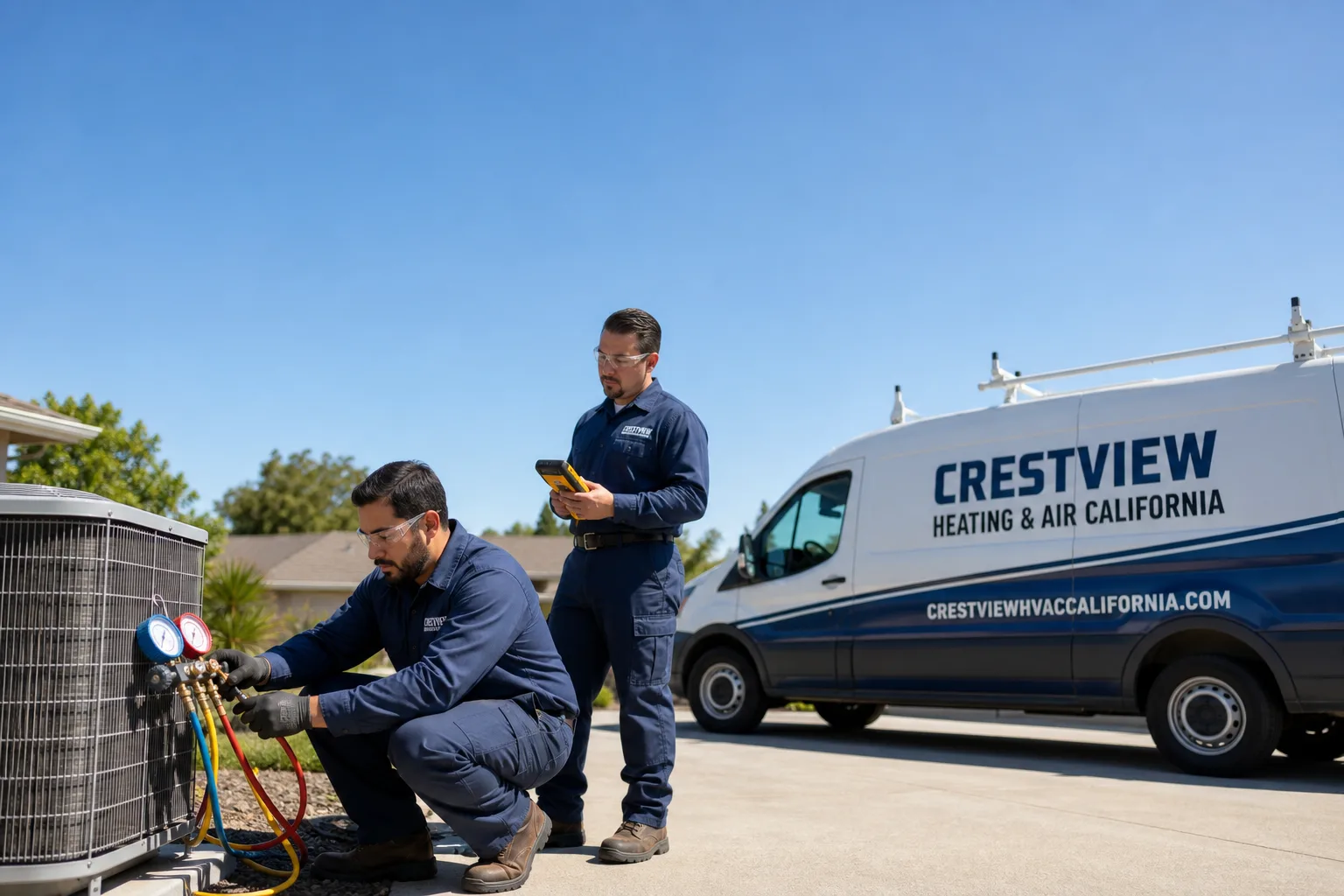
Fast, Reliable Air Quality & Ventilation Across Stanford
Air quality and ventilation work in Stanford demands more than standard HVAC know-how. We’re Crestview Heating & Air California, and our Air Quality & Ventilation team has spent nearly two decades navigating the specific challenges of this university enclave. From faculty homes on ground leases near Mayfield Avenue to research buildings along Campus Drive, we understand the approval layers and microclimate factors that make Stanford unique. Call us at (844) 560-6978 for a free estimate.
Stanford sits at the base of the Santa Cruz Mountains in a recognized fog corridor, producing summers that routinely stay in the upper 60s to low 70s°F. That’s measurably cooler and more humid than inland Palo Alto just a mile or two east. This microclimate means central cooling is rarely cost-justified in residential work, but efficient forced-air heating, ventilation, and condensation management are the core selling points for any HVAC upgrade.
Why Crestview Heating & Air California Is Stanford’s Preferred Air Quality & Ventilation Company
Our 4.8-star average across 250+ customer reviews reflects consistent real-world performance, and we’ve earned that trust through repeated work in ZIP 94305. Owner Marcus Feldman serves as Service Manager, which means ownership-level accountability is built into daily operations, not just the sales pitch. When you call Crestview, you’re not reaching a dispatch center that outsources to anonymous technicians.
We’re familiar with Stanford’s ground-lease housing stock, the university’s facilities coordination requirements, and the Santa Clara County permitting that runs parallel to Stanford Real Estate approvals. Our response time to Stanford is typically same-day or next-day for standard calls, and we maintain emergency HVAC service availability for urgent situations.
We recently upgraded the ERV system in a faculty home on Mayfield Avenue, where the original 1960s ductwork caused persistent humidity issues. By installing a new Lennox HRV and rebalancing the supply registers for Stanford’s foggy microclimate, we eliminated condensation on the custom casement windows without altering the home’s historic floor plan. That’s the kind of problem-solving that comes from nearly two decades of HVAC experience in this specific market.
Our Air Quality & Ventilation Services in Stanford
ERV/HRV System Installation & Replacement
Energy Recovery Ventilators and Heat Recovery Ventilators are the workhorses of Stanford residential HVAC. Because cooling loads are minimal here, the priority is fresh-air exchange without losing heating efficiency during damp winter mornings. We size ERV and HRV systems for the original duct layouts common in 1950s–1970s faculty housing, then rebalance supply and exhaust registers to match Stanford’s humidity patterns. A typical ERV installation in Stanford runs $2,800–$5,400 depending on home size and existing ductwork condition.

Dehumidifier Installation
Stanford’s fog corridor creates moisture problems that inland Bay Area homes simply don’t experience. We’ve found persistent condensation behind custom millwork in ground-lease homes where original duct layouts designed for mild Bay Area conditions cause poor airflow balancing when systems are upgraded. Whole-home dehumidifiers integrated with your existing forced-air system typically cost $1,800–$3,600 installed in Stanford, and they’re often the most cost-effective air quality improvement for this specific climate.

Ventilation Installation & Duct Modification
New ventilation work in Stanford faculty housing frequently requires Stanford Real Estate approval in addition to Santa Clara County permits. We handle that coordination, and we design around the architectural constraints of homes that weren’t built for modern mechanical systems. Ventilation installs here range from $2,200–$6,500 depending on whether we’re modifying existing ductwork or adding dedicated fresh-air ducting to a historic floor plan.

UV Air Purifier Installation
UV-C lamp systems mounted in ductwork or air handlers target biological growth, which matters in Stanford’s humid conditions where mold can establish behind walls before homeowners notice musty odors. We install UV purifiers compatible with the nine major brands we service, including Trane and Lennox systems common in campus-adjacent properties. Expect $650–$1,400 for a professional UV air purifier installation in Stanford.

Air Filtration Upgrades
High-MERV and HEPA-grade filtration helps with both pollen from the foothills and particulates from campus construction activity. We specify filters that won’t overtax the blower motors in older systems, particularly important in ground-lease homes where full system replacement faces approval delays.

Humidifier Installation
While dehumidification is the more common need, winter heating can drop indoor humidity below comfortable levels in well-sealed homes. We install steam and bypass humidifiers sized for Stanford’s moderate heating loads, typically $900–$2,100.

What happens when you call
- 1
A real person answersNo phone trees — you reach a local pro.
- 2
You get an upfront price rangeHonest numbers before anyone is dispatched.
- 3
A background-checked tech heads outLicensed & insured, dispatched right away.
- 4
You approve before work beginsNothing starts until you say go.
Trusted Brands We Service in Stanford
Your system, our specialty. We maintain factory-trained compatibility across nine major brands, and for Stanford customers we stock common parts for Trane, Lennox, Goodman, and Rheem systems. That local parts inventory means faster turnaround when your ERV blower motor fails during finals week or your dehumidifier control board quits before a dinner party. We’ve worked on virtually every system type, age, and brand a Stanford customer could own, from vintage Carrier units in 1960s faculty housing to newer Daikin mini-splits in campus administrative buildings.
Common Air Quality & Ventilation Problems We See in Stanford Homes
- Condensation on custom casement windows. Stanford’s fog corridor delivers humid air that meets cool glass surfaces in homes with original duct layouts. We see this repeatedly in ground-lease properties near the foothills where supply registers were never balanced for moisture management.
- Mold behind custom millwork after system upgrades. When homeowners replace heating systems without rebalancing airflow, the original duct designs create dead zones where moisture accumulates. We’ve remediated this in multiple faculty homes between Campus Drive and Arboretum Road.
- Delayed ventilation upgrades due to ground-lease restrictions. University ground-lease restrictions often require Stanford Real Estate approval for any mechanical alteration, delaying needed ventilation upgrades in faculty housing. We build that approval timeline into our project planning so customers aren’t caught off-guard.
- Poor fresh-air exchange in tightly sealed historic homes. The 1950s–1970s housing stock near Mayfield Avenue and other faculty neighborhoods was built loose enough to breathe, but subsequent weatherization has trapped indoor pollutants. ERV installation solves this without the energy penalty of opening windows.
Pricing for Air Quality & Ventilation in Stanford, CA
We believe in upfront pricing, not vague “it depends” deflections. Here’s what air quality and ventilation work typically costs in Stanford’s market:
| Service | Typical Range in Stanford |
|---|---|
| UV Air Purifier Installation | $650–$1,400 |
| Whole-Home Humidifier | $900–$2,100 |
| Whole-Home Dehumidifier | $1,800–$3,600 |
| ERV/HRV System Installation | $2,800–$5,400 |
| Ventilation Install / Duct Modification | $2,200–$6,500 |
| Air Filtration Upgrade (media cabinet) | $450–$1,200 |
Costs vary with home size, existing ductwork condition, and whether Stanford Real Estate approval adds coordination time. We provide exact written estimates before any work begins, and estimates are always free. Call (844) 560-6978 to schedule.
Stanford’s Unique Ventilation Landscape: What We’ve Learned
This page replaces generic ventilation advice with Stanford-specific protocols for ground-lease homes and campus research exhaust systems, saving faculty and staff from costly permitting mistakes.
In the university’s research complex, HVAC technicians must schedule fume-hood and biosafety-cabinet work around active lab experiments and coordinate with EH&S for shutdowns—a layer of complexity absent from residential jobs in neighboring Palo Alto. While our primary focus is residential and standard commercial service, that campus exposure has sharpened our approach to any ventilation work where downtime isn’t an option. We apply the same scheduling rigor and safety-protocol awareness to faculty home ERV installations, where research deadlines and family schedules both demand precision.
24/7 research exhaust systems on campus cannot be shut down for maintenance without coordinating with the university’s EH&S and the affected lab group, a scheduling hurdle unfamiliar in surrounding cities. This institutional knowledge informs how we plan our residential work too: we don’t promise same-day completion until we’ve assessed whether your ground-lease home requires Stanford Real Estate notification.
We Also Serve Cities Near Stanford
Our service radius extends throughout the Peninsula and South Bay. We regularly provide air quality and ventilation service to Palo Alto just east across El Camino Real, Atherton to the north, East Palo Alto, and Los Altos Hills to the southeast. Each community has distinct housing stock and microclimate factors, and we calibrate our recommendations accordingly rather than applying a one-size-fits-all approach.
Serving Stanford, CA — Our Local Coverage Area
We’re based in the Stanford area and know this community well. Use the map below to see our service coverage — if you’re nearby, we can almost certainly help.
FAQs — Air Quality & Ventilation in Stanford
Yes, most mechanical alterations in university ground-lease housing require Stanford Real Estate approval in addition to Santa Clara County permits. We handle that coordination as part of our project planning, and we build the approval timeline into our schedule so you’re not caught off-guard. Call (844) 560-6978 for a free estimate that includes the full approval pathway.
Stanford’s fog corridor delivers humid air that condenses on cool glass surfaces, especially in homes with original duct layouts that were never balanced for moisture management. We typically solve this with proper ERV or HRV sizing combined with supply register rebalancing, not by replacing your windows. Call (844) 560-6978 and we’ll assess your specific airflow pattern.
No, campus laboratory fume hoods and biosafety exhaust systems require specialized contractors credentialed through Stanford’s facilities procurement system. Our residential and standard commercial service does not extend to research laboratory HVAC. For campus building needs, contact Stanford’s facilities management directly.
Usually not for residential properties. Stanford’s summer temperatures routinely stay in the upper 60s to low 70s°F, making central cooling rarely cost-justified. Your money is better spent on ventilation, dehumidification, and efficient heating. Call (844) 560-6978 for a free assessment of what air quality improvements actually make sense for your specific home.
We’ve had excellent results with Lennox HRV systems in Stanford’s 1960s faculty housing, particularly when paired with careful duct rebalancing. The key is matching the unit to your existing duct capacity and your home’s specific humidity load, not just picking a brand. Call (844) 560-6978 for an exact specification.
Ready to solve your Stanford home’s air quality or ventilation problem? Call Crestview Heating & Air California at (844) 560-6978 for a free, no-obligation estimate. Owner Marcus Feldman still manages jobs in the field, and we’ll give you the straight answer on what your ground-lease home needs, what Stanford Real Estate requires, and what it will cost.
Written by Marcus Feldman, Owner and Service Manager at Crestview Heating & Air California, serving Stanford and the greater San Jose area since 2005.